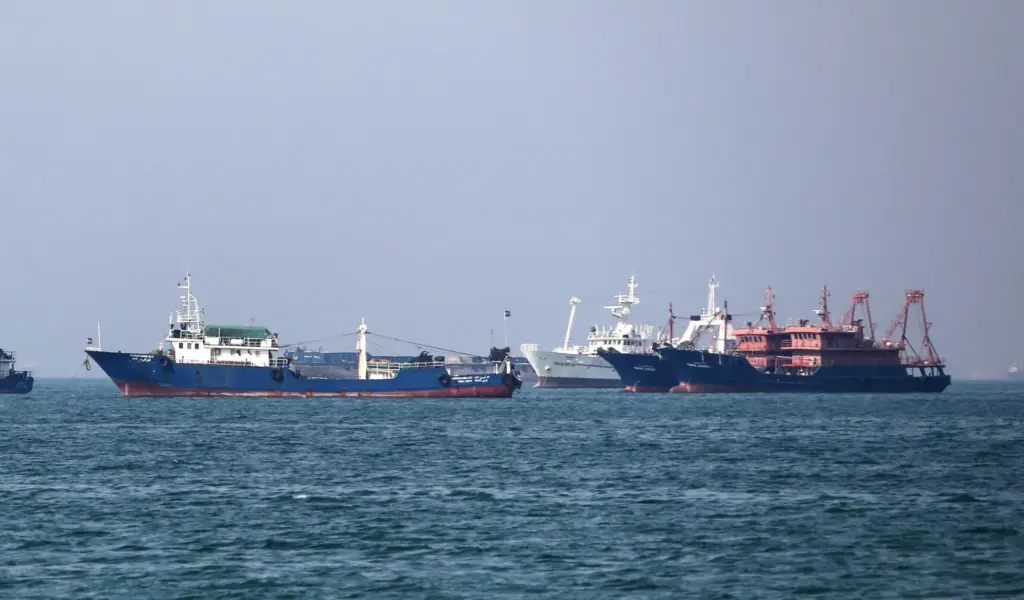

KABUL (Pajhwok): The United States military has announced plans to impose a naval blockade on Iranian ports starting Monday, following the collapse of negotiations in Pakistan, according to media reports.
In a statement released Sunday evening, the US Central Command (CENTCOM) said the measure would affect “all maritime traffic entering and leaving Iranian ports” beginning at 10:00 a.m. Eastern Time (14:00 GMT) on April 13, Al Jazeera reported.
The restriction applies to vessels of all nationalities operating in Iranian coastal waters, including those along the Persian Gulf and the Gulf of Oman.
However, CENTCOM clarified that the operation would not interfere with freedom of navigation through the Strait of Hormuz for ships traveling to or from ports outside Iran.
This appears to be a narrower approach compared to earlier remarks by President Donald Trump, who had suggested a broader blockade of the entire strait, including action against vessels paying transit fees to Iran.
Following the announcement, global oil markets reacted sharply. US crude prices rose by 8 percent to $104.24 per barrel, while Brent crude—the international benchmark—climbed 7 percent to $102.29, according to Al Jazeera
Tensions in the region have escalated significantly since February 28, when the United States and Israel launched military operations against Iran. Since then, Iran has effectively tightened its grip on the Strait of Hormuz, a critical route for global energy supplies. Traffic through the passage has dropped dramatically, disrupting nearly 20 percent of the world’s oil and liquefied natural gas shipments.
While Iran has continued to move its own vessels through the strait, it has permitted limited access to foreign ships. Iranian authorities have also indicated that a toll system for passage could be introduced once hostilities subside.
Responding to the US announcement, Iran’s Islamic Revolutionary Guard Corps warned that any approaching military vessels would violate a ceasefire agreement between the two countries—currently set to last until April 22—and would face a strong response.
The US decision to proceed with the blockade appears to be linked to the breakdown of talks held in Islamabad, which had raised hopes for de-escalation. Iranian officials accused the US delegation of undermining the negotiations. Foreign Minister Abbas Araghchi said American representatives altered key terms at a critical stage, despite the sides being close to reaching a memorandum of understanding.
Meanwhile, Parliament Speaker Mohammad Baqer Ghalibaf, who led Iran’s delegation, stated that Washington failed to build trust during the discussions.
US Vice President JD Vance said that the talks ended without agreement after nearly 21 hours of negotiations, adding that the outcome was more detrimental to Iran than to the United States.
sa