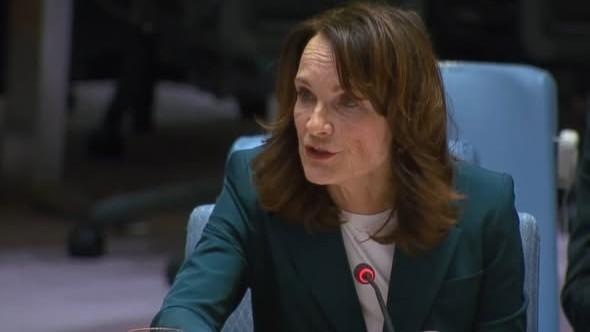

KABUL (Pajhwok): Director of the United Nations Assistance Mission in Afghanistan (UNAMA) Georgette Gagnon says despite relative security, improvements in some economic indicators and the absence of any serious armed or political challenge to the Islamic Emirate of Afghanistan (IEA), the country continues to face economic, humanitarian and human rights challenges.
Gagnon, who is also Deputy Special Representative of the UN Secretary-General for Afghanistan, made the remarks at a meeting of the United Nations Security Council (UNSC) in New York on Monday.
She said that in recent weeks she had travelled to different parts of Afghanistan, including remote areas, northern provinces and eastern crossing regions and had heard common concerns from returnees, traders, affected families, women and girls about growing economic, humanitarian and human rights pressures.
She noted: “On the surface, Afghanistan under the de facto authorities remains stable. Territorial and administrative control has been consolidated and there is no meaningful armed or political challenge to their rule.”
Gagnon added that IEA officials regard the provision of nationwide peace and security as their greatest achievement, but Afghanistan’s long-term future largely depends on developments within the governing structure and how ideological policies are balanced with pragmatic approaches.
She said what is currently being witnessed is increased control by IEA without a clear vision of the final outcome.
Gagnon added that macroeconomic indicators reflect elements of stabilisation: economic growth has been positive in absolute terms, with some long-term investments in infrastructure, fiscal stability has been maintained and revenue mobilisation has improved.
According to her, relative stability has also allowed for positive measures such as the sustained near-eradication of poppy cultivation.
However, Gagnon warned that current efforts to achieve economic stability remain fragile and that the most significant risk is a sudden increase in population resulting from the large-scale return of migrants from neighbouring countries.
She said that since 2023, nearly 5.9 million Afghans had returned to the country, equivalent to an increase of more than 10 percent in the population, and that a further 2.8 million Afghans are expected to return this year.
According to her, many returnees possess few assets and are returning to communities and an economy that lack the capacity to fully absorb them.
Referring to a World Bank report, she said Afghans are becoming poorer in real terms and that Afghanistan remains one of the world’s largest humanitarian crises, with around 21.9 million people, equivalent to 45 percent of the population, expected to require humanitarian assistance in 2026.
The head of UNAMA said that more than half of Afghanistan’s population is under the age of 25 and that this generation is reaching adulthood at a time when opportunities, particularly for girls and increasingly for boys, are becoming more limited.
She added that limited employment opportunities, declining household incomes, increased competition for scarce jobs, prolonged droughts, water shortages and environmental degradation threaten agricultural livelihoods, which remain the main source of income for more than 70 percent of Afghans.
According to her, the convergence of these trends increases the risk of further migration, social, political and economic isolation, greater insecurity and possible susceptibility to extremism.
In another part of her remarks, Gagnon said Afghan women and girls continue to face restrictions that will have long-term and intergenerational consequences for Afghan society as a whole.
According to her, around 3.8 million girls between the ages of seven and 18 are deprived of education, including more than 2.6 million adolescent girls.
She added that each year around 250,000 more girls are permanently excluded from secondary education, a situation that, in her words, deprives the country of a generation of talent and potential.
Gagnon said a recent UNICEF analysis found that restrictions on women’s education and participation in the workforce are already harming Afghanistan’s economy and weakening the country’s long-term development prospects.
She added that the health and education sectors are facing a decline in the number of female professionals and that more than 25,000 skilled workers are expected to be lost by 2030.
She said the situation is reducing access to healthcare services for Afghans, particularly women and children, and worsening maternal and child health outcomes.
She once again called on the Islamic Emirate to lift restrictions imposed on the education and employment of women and girls, including restrictions preventing Afghan female UN staff from accessing UN offices.
Regarding regional relations, Gagnon said relations between Afghanistan and Pakistan remain tense, with border crossings remaining closed and security incidents and military posturing continuing between the two sides.
She added that border closures disrupt trade flows, reduce access to markets, increase the cost of goods and hamper humanitarian operations and access to vulnerable populations.
According to her, civilian casualties in cross-border incidents demonstrate that ordinary people on both sides of the border are paying the price for political disputes that should be resolved through diplomacy.
Gagnon said UNAMA supports sustained efforts to reduce tensions, establish a lasting ceasefire, reopen border crossings, particularly for humanitarian assistance, and pursue peaceful dialogue to resolve differences.
She welcomed ongoing efforts by member states to ease tensions and create channels of dialogue between Pakistan and the Islamic Emirate.
In the final part of her remarks, the acting head of UNAMA stressed that the United Nations’ engagement with the Islamic Emirate does not amount to recognition of the current government, but is necessary to better understand the situation, facilitate dialogue, support the Afghan people and manage risks.
She said UNAMA and UN agencies in Afghanistan continue to maintain an active presence through their headquarters and eight field offices, remain in contact with people and local communities, support humanitarian assistance and basic needs, and monitor and report on political and human rights developments.
She added that UNAMA remains in regular contact with Islamic Emirate officials across Afghanistan and that despite differences, channels of dialogue remain open and frank.
Gagnon described the Doha Process as the current framework for discussions on Afghanistan’s key political issues and said its goal is to achieve an Afghanistan that is at peace with itself and its neighbours, reintegrated into the international community and fulfilling its international obligations for the benefit of its people.
She said that three years after the first meeting of special envoys on Afghanistan, progress had been made towards a more comprehensive approach, but much work remained to be done.
Gagnon called on the Islamic Emirate to establish a regular mechanism for greater engagement with UNAMA on these issues and urged member states to make clear in their contacts with the Islamic Emirate that Afghanistan’s reintegration into the international system remains possible through practical, balanced and cooperative steps.
She said UNAMA remains committed to achieving the Security Council-endorsed objectives for Afghanistan and that continued dialogue, coordinated diplomacy and principled and pragmatic engagement can help make progress in support of the Afghan people.
kk