



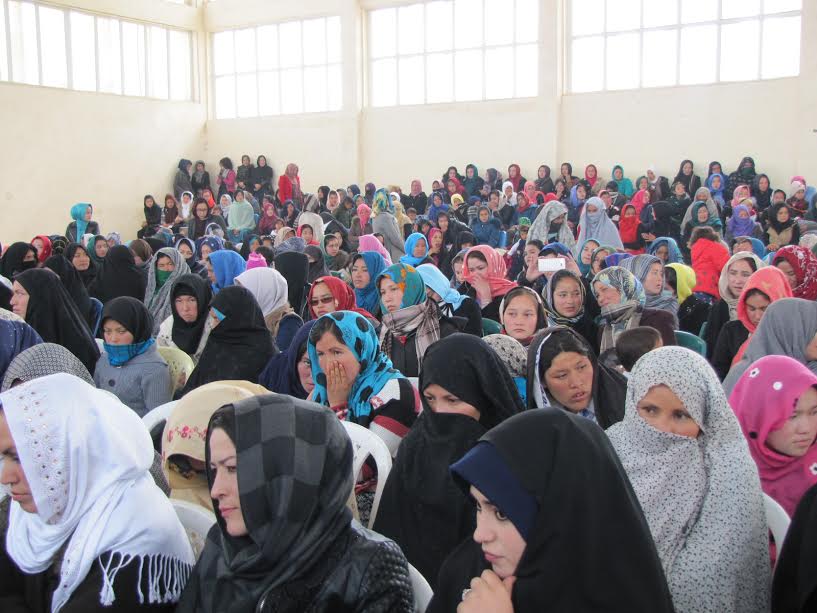

KABUL and district council elections, scheduled for October 20.
Kalsum, 65, is a resident of Neili, the provincial capital. Her knowledge of the process is almost zero, the woman says, implying insufficient awareness might undermine election credibility.
She told Pajhwok Afghan News: “No official from the Independent Election Commission (IEC) has visited our village to inform the people about what election is and how to cast votes.”
Sometime back the women in the neighborhood encouraged Kalsum to attach a special sticker to her tazkira. She has done so, but the woman still does not know how to cast her vote.
Bias, lack of trust, a negative public mindset, restrictions on girls’ education and gender discrimination are some of the reasons for women’s negligible role in events of national importance. Many women in far-flung areas have no information about how to take part in the polls.
Meanwhile, some women in different parts of the country fault the IEC awareness policy. They grumble about the commission’s failure to conduct awareness programme for women.
Some women who have registered as voters say they are not allowed to vote according to their conscience. Family elders have allegedly directed to them to vote for specific persons.
Rehana, a resident of the Ingil district of Heart who has no idea about the election process, says: “I agreed with my brother and registered as a voter. However, I don’t have any awareness regarding the elections.”
She acknowledges the awareness programme is not going well and negligence has been committed in this regard.
Nazefa, a government servant in Faryab province, has got another tazkira with a sticker attached due to threats from the Taliban. She is not interested in voting because she was disappointed with casting her ballot in the past Wolesi Jirga elections.
“I would vote for someone who gives me 5,000 afghanis,” she says, terming insecurity the main reason for her disinterest. “Looking at the current security situation, women may not be able to fully participate in the polls,” she predicts.
Gul Bibi, 36, registered as a voter in Ferozkoh, the capital of western Ghor province. But her awareness regarding polls is next to nil.
Maryam, 25, a resident of the fifth municipality district of Faizabad, the capital of Badakhshan province, recalls: “I took part in the voter registration process but programme regarding awareness are so weak.”
Shamsia, hailing from Chora district of Uruzgan, said: “Due to unawareness, I took my husband’s tazkira to attach a sticker with to the registration centre. Then I took there a copy of my own card before I had my original ID card stickered.”
An inhabitant of the Zaho locality of Gardez, the capital of Paktia province, Zarmena says: “I have attached a sticker to my tazkira to take part in the election. But don’t have enough information regarding the process.”
Reba, a resident of Balk province, declares: “I don’t want to participate in the election, which is of no importance for me. My vote will not make any difference,” she comments, without going into details.
Durkhanai, hailing from Paktika province, says her husband reserves the right to decide who I should vote for. Thus she will cast her vote for the one recommended by her husband. My tazkira is with my husband and it is up to him to decide whm we will support.”
Civil society activists
Malalai Alwi, a civil society activist in Herat, said: “I am not optimistic about transparency in the upcoming elections, because the IEC launched no effective programmes for public awareness during the voter registration process.”
Laila Hussaini, a civil society activist in Daikundi province, also took issue with the poll panel on women’s awareness. She expressed concern about women’s inexperience about elections and said females in most districts were uneducated and they might be deprived of voting.
Wolesi Jirga candidates’ views
Tafseer Siahposh, a Wolesi Jirga candidate from Kabul, slammed the failure of the relevant quarters to inform women in rural areas about elections. He thought the panel should have launched awareness programmes months before the election, as women in remote areas had no information in this regard.
The public awareness drive was too late to produce the desired results, he insisted, asking the Ministry of Women Affairs and the commission to educate the people, particularly women, on the election process.
Rohina Walizai, a Wolesi Jirga runner from Maidan Wardak province, said, “I personally have no information about the elections. However, I have improved my awareness through participation in seminars and workshops. IEC should inform both men and women on why they must take part in the polls.”
Hajira Aryubi, a poll contestant from Uruzgan province, also expressed concern at the little awareness among women, saying females in the province did know much about the electoral process, including how to vote.
She also hit out at the government for its inability to improve the security situation in Uruzgan. She said security should be a priority before conscientising the public about the vote.
Huma Ahmadi, a lower house aspirant from Logar province, said: “The IEC has a special commission for boosting public awareness. Its staffers have been drawing salaries, so they must tell the public how to vote and participate in elections.” She suggested schoolteachers and university lecturers should also educate students about the election process.
Storai Yazdanparast, a Wolesi Jirga candidate from Badakhshan, said women’s knowledge regarding elections in the province was very low and the people did not know how to vote or who to vote for. She revealed most government and NGO officers had removed voter stickers from their identity cards due to threats from the Taliban.
“We are very concerned because people in remote areas have no awareness about elections. If they vote in a wrong way, the commission may invalidate their ballots. The IEC has been indifferent on the issue of lack of awareness,” she continued.
Oversight commissions
Free and Fair Election Foundation of Afghanistan (FEFA) head Yousuf Rashid said they were worried at the low levels of public awareness, particularly among women, regarding elections.
“The limited activities seen on the awareness front have been ineffective,” he alleged, arguing negligence in the area caused only a small number of women to take part in the electoral process.
Public awareness about elections would improve people’s knowledge and help build public trust in the election process and encourage the masses to vote in large numbers, Rashid believed.
He admitted the current awareness drive of the poll panel was not effective. FEFA has asked the organs concerned several times to make the public awareness program an ongoing process.
“Since women are more affected by inexperience about the election process, they go by what their families decide on their behalf. Their understanding level is very limited, so they agree with family elders on who to vote for,” he added.
Independent Election Commission
Zabihullah Sadat, deputy spokesman for IEC, said the commission had launched the public awareness programme, particularly for women, two days ago and it would continue until the election day.
He said encouraging people to vote, educating them on the process and other things were part of the programme that would be aired by TV channels and radio stations. The programme will be promoted through newspapers, social media networks, preachers, posters, brochures and video clips.
Around 800 public-awareness billboards would be installed in provincial capitals and district centres while 900 flipcharts for those involved in conscientising, 420,000 posters, 800,000 informative papers and 1.2 million brochures have been printed. They would be delivered to the mentioned areas, Sadat said.
He added the IEC had also created a helpline, 190, run by 60 personnel to provide information to people about polls. The service remains available from 7am to 8pm every day. A number of other government entities such as the Ministry of Islamic Affairs and Hajj, Ministry of Women Affairs and relevant organs have been asked by IEC to provide uneducated women with awareness about elections in rural areas.
mds/nh/mud


GET IN TOUCH
NEWSLETTER
SUGGEST A STORY
PAJHWOK MOBILE APP