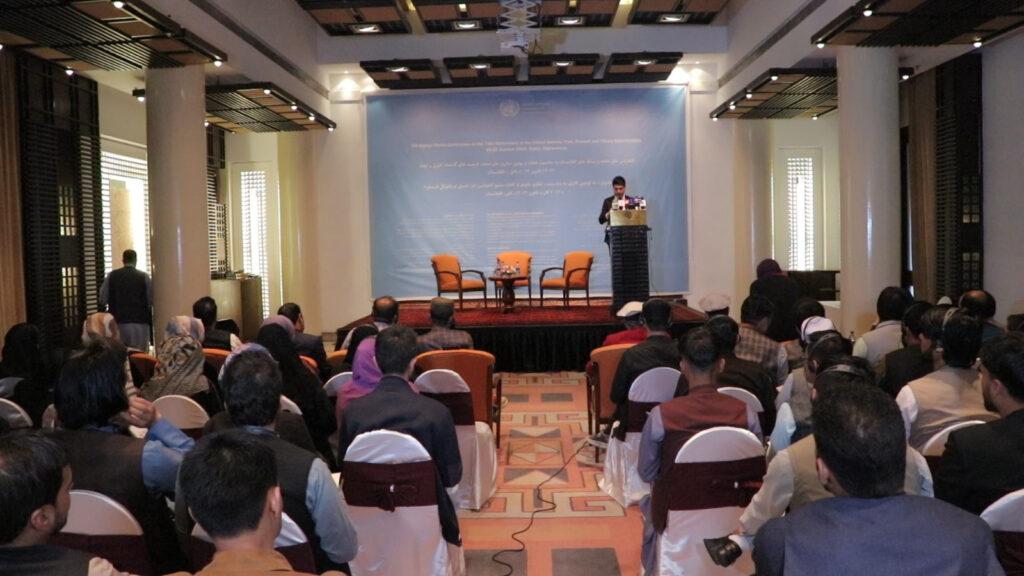
KABUL (Pajhwok): The United Nations Educational, Scientific and Cultural Organization (UNESCO) has reported the killings of 1,714 journalists worldwide since 1993.
Director of UNESCO office in Kabul Patricia McPhillips addressed a conference commemorating the 79th anniversary of the United Nations on Wednesday.
The UN Day Conference on Past, Present, and Future Opportunities for UN and Afghan Media emphasised on the fundamental values of impartiality, humanity and independence that unite the UN and the media.
This gathering served as a reminder of the critical partnership between the two entities in promoting peace and prosperity in the region.
McPhillips highlighted the media's essential role in informing the public and the international community about UN activities and advocating for peace and prosperity.
She noted that UNESCO had been tasked within the UN to effectively guarantee freedom of expression.
About the global status of journalists, she said, “In recent years, we have witnessed unprecedented attacks on journalists. Across the world, journalists face harassment, imprisonment, violence, or death simply for doing their jobs. The imprisonment of journalists is at a record high.”
She added, “Celebrating UN Day with journalists and representatives of the media in Afghanistan is particularly fitting, as the UN and the media share fundamental principles and values --impartiality, humanity and independence.”
McPhillips called journalists indispensable partners for UN employees working in Afghanistan, playing a crucial role in informing the population about UN mandates and programmes, as well as amplifying calls for continued international support.
The conference also addressed broader challenges facing the media, including the rise of online violence and harassment, which could lead to self-censorship and physical attacks on journalists.
UNESCO’s Observatory of Killed Journalists reports that 54 journalists have already lost their lives this year.
In the context of rapid technological change, McPhillips pointed out that social media and digital platforms had empowered communication, becomig breeding grounds for disinformation, hate speech and conspiracy theories.
She stressed the need for ethical journalism and independence, noting UNESCO's efforts to develop guidelines for governments and digital companies to combat these issues.
Hate speech and even incitement to genocide, as is a well-known case of the radio station in Rwanda whose managers were criminally responsible by an international tribunal court for genocide and incitement to genocide and crimes against humanity before and during the 1994 genocide of the ethnic Tutsi people of Rwanda.
The Internal Division of Labor within the UN has delegated to UNESCO the responsibility of working through international cooperation to guarantee that the freedom of expression is effectively ensured through a free... There's too much stuff up here.
Internal Division of Labor within the United Nations system has delegated to UNESCO the responsibility of working through international cooperation to guarantee that freedom of expression is effectively ensured through a free, plural, independent, and diverse media system.
In that regard, UNESCO has developed several tools to monitor the situation of the media and guidelines to address the challenges that hamper the positive role in society.
“I invite you to follow me for a quick overview of the brief reflections on these current challenges,” the UNESCO director said.
In recent years, she added, they had witnessed unprecedented attacks on journalists. Worldwide, journalists face harassment, imprisonment, violence, or death simply for doing their jobs. Journalists' imprisonment is at high records.
Online violence and harassment spur self-censorship and sometimes physical attacks. Journalists have also increasingly been attacked while covering protests by various actors, including both security forces and protest participants. According to the records collected by UNESCO's Observatory of Killed Journalists, 1,714 journalists have been killed since 1993.
This year alone, the death toll is at 54. UNESCO's Observatory of Killed Journalists provides updated information on the killing of journalists and on the judicial status of condemned cases since 2006.
It also provides public access to global wide country responses to UNESCO's requests for information into the judicial status of ongoing and unresolved cases.
Social media and other digital platforms have empowered people all over the world to communicate, share information and transform societies. But increasingly, these platforms are breeding grounds for disinformation, hate speech, and conspiracy theories.
Studies show that engagement can often be prioritized at any cost. This leads to algorithms favoring the most controversial content because it triggers the most reaction.
Social media and emergence of citizen journalism has blurred the line between journalism and activism, and at the same time has highlighted the importance of independence and ethical journalism.
In this regard, UNESCO has read a global dialogue to develop guidelines for governments, regulatory bodies, and digital companies to combat hate speech and misinformation.
As the event concluded, attendees reaffirmed their commitment to fostering a free, independent and diverse media landscape, recognising its vital role in ensuring informed societies and promoting peace.
sa/mud
GET IN TOUCH
NEWSLETTER
SUGGEST A STORY
PAJHWOK MOBILE APP