



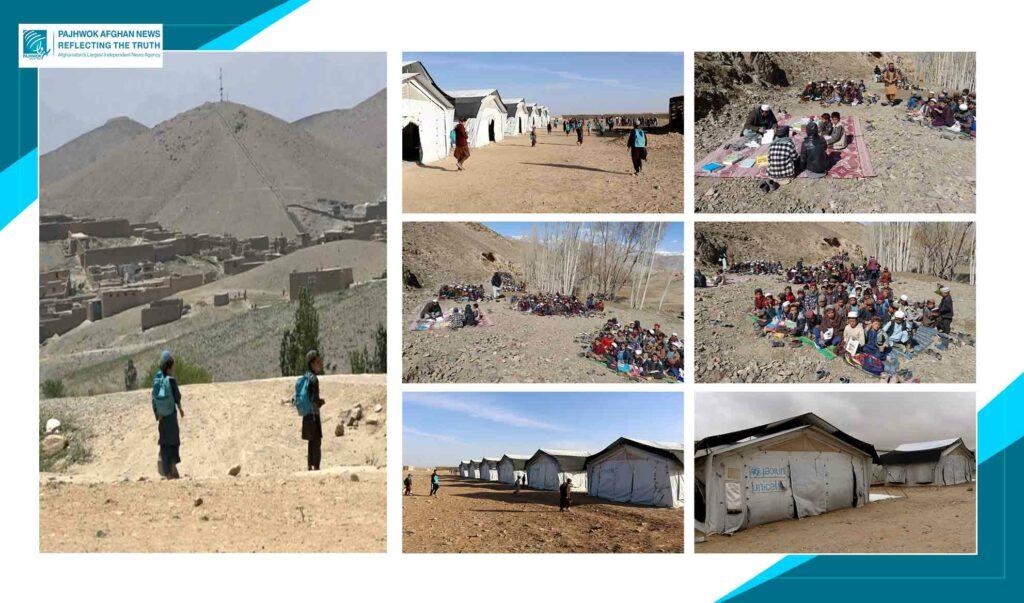

GHAZNI CITY (Pajhwok): The Department of Education says around 250 out of 771 schools in southern Ghazni province still lack buildings and their students study under the shade of trees and walls.
Education Director Maulvi Nasir Ahmad Husaini told Pajhwok Afghan News schools without buildings were located in Ghazni city and nearly all of 18 districts. Some were damaged during past conflicts and have not yet been rebuilt.
He explained approximately 150,000 students have been studying under the open sky for several years due to a lack of proper infrastructure.
He added 28 such schools were located in Ghazni city, 20 in Nawa, 12 in Giro, eight each in Khwaja Omari, Jaghori and Ajristan, nine each in Muqur and Andar, 18 in Gelan, six in Zankhan, eight in Rashidan, 15 in Deh Yak, 14 in Jaghatu, 12 in Nawur, 14 in Ab Band, 17 in Malistan and 25 in Qarabagh districts.
Husaini said the issue had been shared with officials in capital Kabul and international organisations.
This year, 25 primary schools were being reconstructed at a cost of 250 million afghanis with financial support from the United Nations International Children’s Emergency Fund (UNICEF), he announced.
He expressed hope that more attention would be paid to the remaining schools as well.
Aminullah, a resident of the Shinka area in Gelan district, said there were 26 schools in the district, but only eight had proper buildings. The rest operate without any infrastructure.
He noted the lack of school buildings posed major challenges for students. On rainy or windy days, schools are closed and in the summer, children sit in the shade of walls to continue their lessons.
Similarly, Sulaiman Gul, a resident of Adamkhel area in Rashidan district, said the district has 120 villages but only eight functioning schools.
According to him, there are two primary, two middle and four high schools in the district. Only two of them— Husainkhel Boys’ School and Khadija-tul-Kubra Girls’ School— have incomplete buildings. Thousands of students in the rest of the district continue to study in difficult and unsuitable conditions under the open sky.
Baryalai, a student at Qazi Sultan Mohammad School in the Tangi area of the same district, said: “Most schools in Rashidan district have no buildings, including ours. When it rains or the wind is strong, our classes are cancelled, which has severely impacted our education.”
In addition to the lack of buildings, he also complained about the shortage of teachers and educational materials.
He said students were forced to study in extreme heat, cold, wind, and rain— a situation that has created serious problems for their learning.
He urged the caretaker government to address the needs of schools that lack buildings or suffer from shortages of teaching staff and learning materials, so more children can access quality education.
Masood Pashtoon, a university professor, said shortcomings in the education sector have a negative impact on students’ learning.
“A disorganised education system— where classes are held irregularly, schools are closed on rainy or windy days, and children sit on the bare ground in the shade of walls during hot weather— is simply unacceptable,” he remarked.
There are a total of 771 schools in Ghazni province — 71 for girls and the remainder for boys.
According to officials, approximately 450,000 students are currently enrolled in these schools, pursuing their education.
kk/ma

GET IN TOUCH
NEWSLETTER
SUGGEST A STORY
PAJHWOK MOBILE APP