

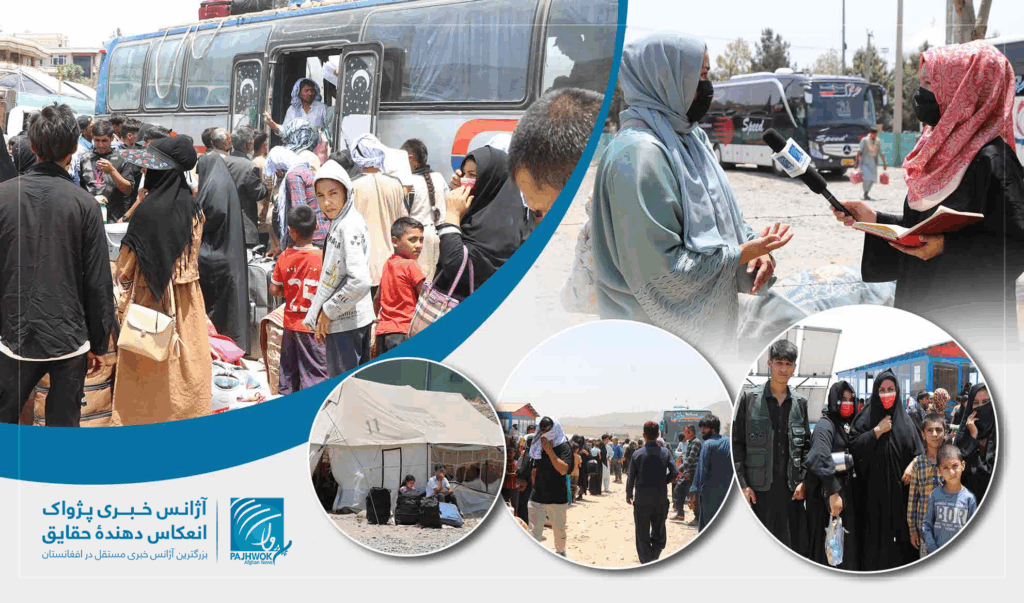

KABUL (Pajhwok): Amid an unprecedented surge in the deportations of Afghan migrants from Iran, thousands of families have returned to the country empty-handed.
Returnees are urging the Afghan government to provide them with shelter and job opportunities.
Meanwhile, human rights experts are calling the forced deportation of migrants a violation of international law and have urged the United Nations to intervene and bring to a halt the practice.
Mass deportation from Iran a violation of human rights: Experts
Experts have strongly condemned the mass and forced deportation of Afghan migrants from Iran, labeling it a clear violation of human rights. They call on the United Nations to take urgent action to stop the ongoing expulsions.
Returnees plead for support
At the transportation terminal in the Sara-i-Shamali area of Kabul, thousands of forcibly returned migrants from Iran arrive daily. Many of these families had initially migrated due to poverty and economic hardships and have now returned with nothing.
Rahila, who returned with her five children, shared her story: “I have three sons and two daughters. At 3 a.m., Iranian police came and said, ‘Didn’t we tell you to return to your country by the fourth month?’ I begged for one more day, but they refused. We grabbed a few clothes, gave the house key to a neighbor for the landlord, and left.”
Rahila, a native of Baghlan province, had worked for years as a cleaner in Iran. Her husband, who struggled with addiction, disappeared two years ago and was never found.
She returned to Afghanistan after seven years. “Life in Iran was hard, but we managed to survive through the efforts of every family member. Now that we’re back, we’re lost and don’t know where to begin,” she said. “We have no home. We don’t know where to go.”
She described how they had gradually built a modest life over the years in Iran—only to be forced to abandon it all overnight.
Deportation from Turkey adds to migrants’ plight
Masuma Khawari, originally from Mazar-i-Sharif, was recently deported from Turkey. She said their visas had not yet expired when they were forcibly removed.
“They tricked us by saying they needed us for an hour. But then we were taken to camps. For ten days, we were moved from one camp to another. Men, women, and children were kept separately, without food or basic facilities. Finally, without any explanation, we were deported.”
Khawari had lived in Denizli, Turkey, for seven years after fleeing economic hardship and insecurity in Afghanistan.
“We had built a basic life there,” she said, glancing nervously at her young children.
“When we arrived back, we had no home, no belongings. At the airport, we were given just one blanket, a couple of winter clothes, and a small amount of cash.”
She described the deportation as one of the most traumatic experiences of her life, having left behind all possessions and personal documents.
Bibi Zainab, a widow from Kunduz province, returned to Kabul three days ago after years of struggle in Iran. One of her sons remains in Iran to collect his unpaid wages.
“We’re searching for a home, but we can’t find anything,” she said, visibly exhausted.
She explained that Afghans in Iran faced regular discrimination, including being denied bread at bakeries and access to basic stores. Only some Herati-owned bakeries would sell bread to Afghan migrants.
She appealed to the international community to stop the forced deportations and assist returnees.
Naser Ahmad Arefi, who returned with 20 family members after 12 years in Iran, now has neither a place to stay nor the money to return to his home province of Takhar.
“We lost 140 million tomans for our house and 100 million tomans in unpaid wages. Now we don’t even have enough money to get to Takhar,” he said.
He left Afghanistan because of economic difficulties and unemployment. Though life in Iran was harsh, he was able to support his family through work.
Arefi also described the rough treatment they received from Iranian police and said all their belongings remained behind. While passing through Nimroz province, he received just 10,000 afghanis in aid—nowhere near enough to meet their basic needs.
Like others, he called on the Islamic Emirate to provide shelter and job opportunities and asked international aid agencies not to abandon them.
Legal Experts: Mass Deportation Violates International Law
Bilal Ahmad Khateer, a legal expert, said: “Under international conventions—especially the 1990 Convention on the Protection of the Rights of Migrant Workers—states have the right to deport migrants. However, this right is not absolute; it comes with restrictions.”
He cited the principle of non-collective expulsion outlined in Protocol No. 4 of the European Convention on Human Rights and Article 22 of the Migrant Workers Convention, both of which prohibit mass deportations—something Iran is clearly violating.
Khateer emphasized that deported migrants have the right to appeal and must not be subjected to inhumane treatment.
“If a migrant poses a security threat, they should be individually assessed—not collectively deported,” he said.
He urged the Islamic Emirate to provide key services such as registration, free transportation to home provinces, healthcare, and shelter for returnees. He also called on the United Nations to pressure Iran to stop the deportations.
Migration Expert Warns of Long-Term Crisis
Abdul Razzaq Adeel, a migration expert, described the mass deportation of Afghan migrants as a “humanitarian disaster” which will have long-lasting consequences.
“This not only creates immediate hardship for thousands of families, but also risks serious social and economic crises in Afghanistan,” he said.
He called on the Islamic Emirate to work closely with international organizations to implement a comprehensive plan to meet the basic needs of returnees.
“Mass deportation is against human values and can cause long-term instability. The international community must increase support to help Afghanistan meet the needs of returnees,” Adeel added.
Over Half a Million Migrants Returned This Month
Abdul Mutalib Haqqani, spokesperson for the Ministry of Refugees and Repatriation, told Pajhwok that more than 576,000 Afghan migrants had returned so far this month (Saratan/July 2025).
“Since the start of Saratan 1404, 576,079 migrants returned from Iran, Pakistan, and Turkey,” he said. “Of these, over 90,000 were single individuals, and more than 400,000 constituted families.”
He said the ministry has provided facilities in areas such as housing, education, and employment for the returnees.
Haqqani acknowledged recent video footage showing the mistreatment of Afghan migrants in Iran. Although the exact locations of the videos remain unverified, he said the reports were concerning.
He urged Iranian authorities to investigate the abuse and prevent further harm to bilateral relations.
According to Haqqani, the Afghan government has made all necessary preparations to respond to the needs of returnees, including financial support, essential services, and transportation to their home provinces. Committees have been established to address migrant issues.
He emphasized that reintegration efforts are ongoing and that the government is committed to protecting the dignity and rights of returnees.
sa/ma


GET IN TOUCH
NEWSLETTER
SUGGEST A STORY
PAJHWOK MOBILE APP