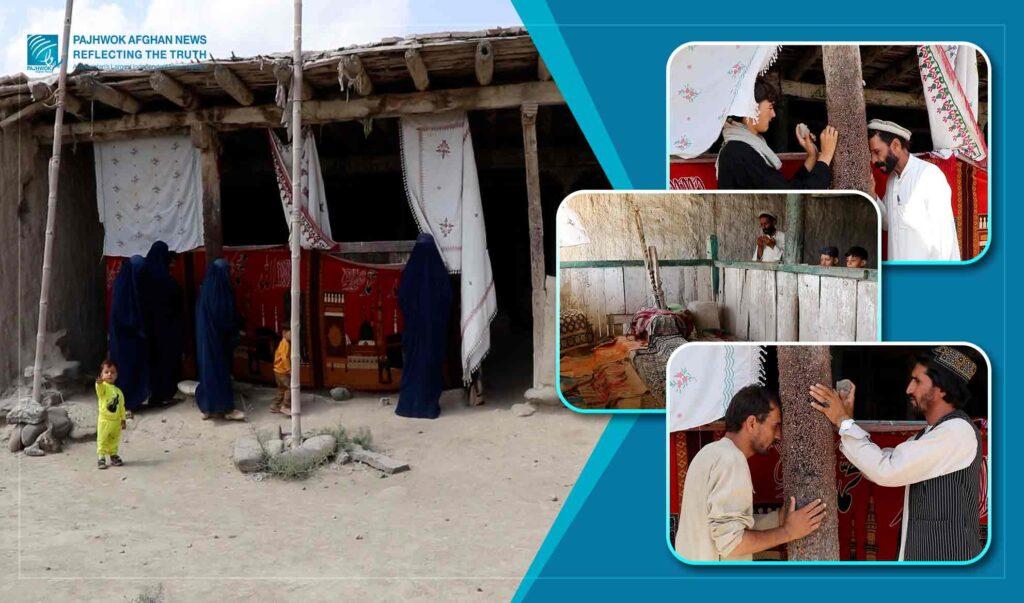

KHOST CITY (Pajhwok): Many people visit a local shrine daily and hammer nails into a wooden post that they believe cure headaches and other ailments in Ismailkhel Mandozai district of southeastern Khost province.
While locals swear by its effects, religious scholars say such practices are against Islamic law and constitute superstition.
The shrine, known as Alam Sher Pir, is located in the Pir Kelay area of Ismailkhel Mandozai district.
People from nearby villages come with the intention of seeking relief from headaches or other illnesses.
Gul Markhan, visiting the shrine with his family, said that he came to pray for the healing of his headache and for the wellbeing of his children.
He laid his head on a wooden post already embedded with thousands of nails hammered by previous visitors, while another person struck a nail to supposedly ease his pain.
“Today I have come to seek relief for my headaches, my children’s continuous crying, or any other problem in my heart. I hope, through the blessings of the deceased associated with this shrine, my troubles will be solved,” he told Pajhwok Afghan News.
Other locals, including Imran, also affirmed that hammering nails on the shrine’s post seems to alleviate pain and brings a sense of relief.
He added that people from distant villages come to the shrine not only for headaches but also to pray for healing from various ailments.
Sherdraz Mohammadi, another resident of the area, said visitors come for different reasons, such as feeling haunted, experiencing shadows over them, or suffering from headaches.
Another local, Rahmanuddin, explained that even crying children were brought to a stone at the shrine with the belief that it would ease their distress.
Social affairs expert Noor Jan Bahir noted that such practices were common in economically and educationally deprived communities.
He said: “When societies lack access to proper healthcare and education, people tend to rely on their beliefs, visiting shrines for psychological reassurance and relief from problems.”
Religious scholars, however, maintain that while visiting shrines and graves is permissible, practices like hammering nails contradict Sharia law and are considered superstition or even shirk (associating partners with God).
Mufti Zohurul Rahman Aryobi, a religious scholar in the province, said: “Visiting shrines and graves is a Sunnah and not sinful. But hammering nails, performing circumambulations, or other acts contrary to Sharia is forbidden. Allah commands that worship be directed solely to Him without associating anyone else.”
Officials from the provincial Information and Culture Department also described these practices as inappropriate and said efforts were ongoing, in coordination with the Department of Vice and Virtue and Complaints, to curb such activities.
Shah Hussain Masjidi, director of the department, added: “Other harmful customs, such as forcing girls into unwanted marriages or giving daughters in bad circumstances, are also being addressed. Gradually, these practices will be eliminated, Inshallah.”
According to sources, in many remote areas of Afghanistan, people still rely on such unscientific methods to treat illnesses and solve problems—practices that religious scholars strongly discourage as superstitious.
kk/ma