


ZARANJ (Pajhwok): Some women engaged in making handicrafts in northwestern Nimroz complain about low income despite their hard work and the lack of direct access to markets. They urge the Islamic Emirate of Afghanistan (IEA) to establish a special marketplace for selling their handmade products.
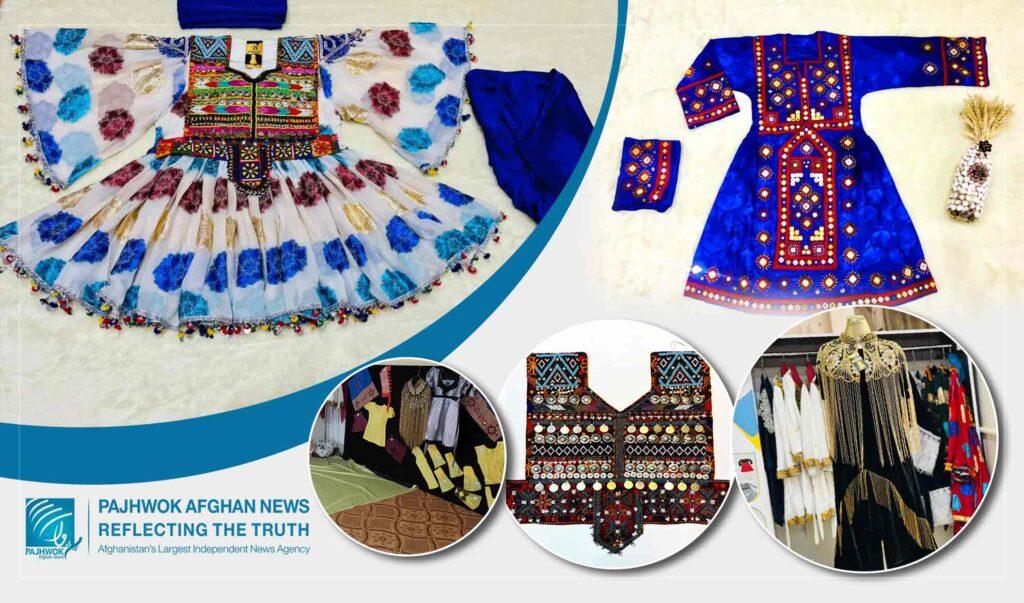
Karima Darwishi, a 50-year-old woman in Zaranj city, supports her family by sewing traditional Balochi dresses known as “Zigpadan Balochi” together with her three daughters.
According to her, “Zigpadan Balochi” is one of the most beautiful and ancient types of traditional Balochi embroidery made by Baloch women. This style is a key part of women’s traditional clothing, especially in Nimroz province. The patterns include geometric shapes, diamonds, stars and small flowers embroidered in colorful threads on cotton and silk fabrics.

Nimroz handicraft women demand market for their products
She said she learned this embroidery from her mother and grandmother and has now taught it to her daughters.
“I am the head of my household. My husband has passed away. I provide for my four children, pay the rent, and cover all our expenses from this work,” she said.
Expressing dissatisfaction with her earnings, she added: “Sewing Zigpadan Balochi takes a lot of patience. We put in so much effort, but in the end, we are only paid 7,000 afghanis, which barely covers our family’s expenses. Believe me, a single outfit costs 10,000 in Iran — about 15 million tomans — and in Europe, it’s sold for up to 300 dollars.”
Karima urged the government to create a special market for women in Nimroz so that the profits from selling their handicrafts go directly into their own pockets.
She added: “In Nimroz province, most women are forced to do this kind of embroidery for very low wages. In our village, there’s a family of 15 people whose women support the entire household through this work.”
Meanwhile, Zarmeena, a 22-year-old woman who has been sewing Zigpadan Balochi dresses and doing embroidery since she was 12, said she has repeatedly helped pay off her father’s debts, paid for her mother’s treatment and managed the family’s expenses through this craft.
She too expressed sadness over the low wages, saying: “This Zigpadan Balochi dress — we work so hard on it, our eyes get weak and our backs ache — yet we are only paid 3,000 afghanis. In Iran, it sells for 10,000 afghanis, and abroad for 300 dollars or even higher. We women do all the hard work, but the profit goes to others.”
She also emphasized the need to establish a dedicated women’s market to solve the challenges faced by women working in handicrafts.
Similarly, Maryam Sultani, a young woman who started flower-making, decoration, and design work at home a month ago, said she has already employed four other women.
She mentioned that she had always been interested in flower-making and, encouraged by friends, started the business with just 1,000 afghanis.
Her first creations were a prayer mat and a flower bouquet. Now she decorates various items — artificial flowers, trays, and flower baskets — for events like henna nights, weddings, birthdays, and circumcision ceremonies, based on customer orders.
Maryam also called on the IEA to create a special marketplace for women artisans so they can easily sell their products and grow their businesses.
She believes that if women are supported, a special market is created for them, marketing is done for their products, and training programs are launched in various areas, their businesses will flourish, and the economic conditions of families will improve.
Meanwhile, Palwasha Shams, the head of the Women’s Chamber of Commerce and Industry in Nimroz, told Pajhwok that recently, many women and girls have turned to small and large businesses — particularly handicrafts, machine sewing, and online trade — which is a promising development.
However, she identified the lack of a dedicated market for women as a major challenge, noting that some women have abandoned handicrafts due to poor sales and high raw material costs, turning instead to other professions.
Shams said that businesswomen in Nimroz are more deprived compared to those in other provinces and need greater support from institutions and the government.
She added that the Women’s Chamber of Commerce and Industry in Nimroz is working with relevant agencies and donors to establish a special market for women artisans and promote their products.
According to her, through the chamber’s efforts over the past six months, training opportunities have been provided to 200 women, and work materials have been distributed among them. She said efforts are ongoing to expand such support for more women.
sa/ma


GET IN TOUCH
NEWSLETTER
SUGGEST A STORY
PAJHWOK MOBILE APP