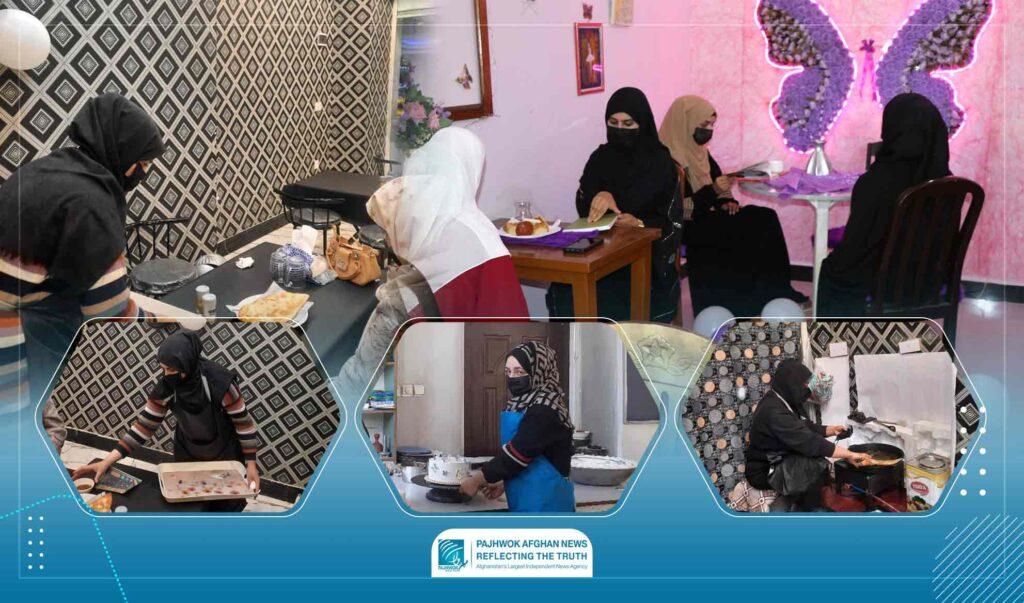

KABUL (Pajhwok): A number of women and girls working in restaurants in Kabul city—ranging from management roles to waitressing and cleaning—have not only created a calm and safe environment for female customers, but are also helping meet the economic needs of their families.
However, in Kabul city, some restaurants have a women-only section, separate from men, where services are provided by female staff, while others are entirely women-only restaurants, where both the staff and the customers are all women.
Tuba Sarwari: Every woman can shape her own life
Tuba Sarwari, 23 years old (not her real name), despite opposition from her family and social pressure, decided to independently determine the course of her life. She has been working as a waitress in one of Kabul’s restaurants for three months.
She says that due to unemployment and economic difficulties, she chose to work in a restaurant. “From the very beginning, my family opposed my working in a restaurant, but despite all the pressure, I decided to continue on my path, because I believe every woman can make independent decisions and follow her own way.”
She once dreamed of becoming a journalist, but economic hardships changed the course of her life. Nevertheless, working in a restaurant has also brought her pleasant experiences.
With a gentle smile, Tuba recalls one of her happiest memories: “One day, a customer appreciated me very much and gave me a tip. That behavior was really encouraging for me.”
However, she says that at times she has also faced inappropriate behavior from some customers.
Despite the challenges of her job, Tuba enjoys her work and considers interacting with people one of her strengths.
She added: “When women and girls come to our restaurant and smile, I feel good. All my tiredness disappears, and I am happy that women like me are happy.”
Having moved beyond judgment and limitations, she now wants to build a better future for herself. She tells other girls: “Working is not shameful; it is an honor.”
Tuba is not alone. Other women have also entered this field and are striving to address the economic problems of their families.
“Kabul Hawasana Hut,” a restaurant founded by a young woman
Nelofar Wahab, a young woman whose face still bears the fatigue of years of migration, is now the owner of a small restaurant in the Qala-i-Fathullah area of Kabul.
In the small, clean kitchen, four women were busy working, and the aroma of freshly made bolani filled the restaurant.
Nelofar, while serving guests, told Pajhwok Afghan News: “Two years ago, we went to Pakistan, where we faced many economic problems. We returned to Kabul three months ago. Unemployment and economic hardship troubled me greatly. I thought I had to do something. Suddenly, I thought of opening a restaurant—starting work with limited facilities and earning halal sustenance with my own hands. I told myself that I could prepare Hawasana very well.”
About a month ago, Nelofar established “Kabul Hawasana Hut” with a capital of 100,000 afghanis, where mantu, ashak, bolani, and soup are prepared for customers.
She works there with her sister, mother, and sister-in-law. She provides services to female customers, while food for male customers is served by her father.
Nelofar hopes that this small hut will one day turn into a large restaurant—one that will provide job opportunities not only for herself, but for many other women.
She, who observes Islamic hijab herself, says in a message to other women: “Women and girls should use their talents. Working in society is not a problem, as long as our sisters observe Islamic hijab and preserve Afghan culture and traditions wherever they are.”
She called on people to respect and support working women so that they can free themselves and their families from economic hardship.
From unemployment to restaurant management: Mahdia’s story of resilience
Mahdia Faiq (not her real name), a 25-year-old woman working in a restaurant in the Dasht-i-Barchi area, previously worked in a non-governmental organization focused on women’s empowerment.
However, after the suspension of humanitarian aid to some organizations by the United States, she lost her job and was forced to look for new work.
She says: “My family opposed my working in a restaurant, but in my opinion, there is no shame in working. I had to find a way to cover our expenses and live a dignified life.”
Mahdia initially started working as a waitress—a job her family never approved of—but her effort and skills led her to her current position as the financial manager of the restaurant.
She is currently also learning online business and hopes that one day she will establish her own business and brand.
She considers women’s employment in various fields a necessity and says: “In the current situation, work is a necessity for women. Many families have no breadwinner, and the unemployment rate is very high. I hope the private and industrial sectors create more job opportunities for girls.”
Samira Mohammadi, restaurant owner: I ask the IEA to support us
Samira Mohammadi (not her real name), the owner of “Afghan Women’s Restaurant” in Kabul, says that with the increasing demand for jobs, she needs support from institutions and the government in order to establish more branches in different areas.
She said: “The motivation was that everyone must work and women should stand on their own feet.
“Afghan Women’s Restaurant’ is the first women-focused restaurant that I established myself almost five years ago.”
She spoke about the growing interest of women in restaurant work, adding: “In the current situation, women are in great need of work. Previously, we ourselves searched for employees, but now demand has increased significantly. Women come and apply for jobs, and unfortunately, we cannot absorb more staff. However, we are trying to establish branches in different areas, and I ask institutions and the government to support us.”
Female cleaner in a restaurant: “I’m happy to raise my children with halal income
Bibi Shirin (not her real name), 45 years old, who works as a cleaner in one of the restaurants in Shahr-i-Naw, Kabul, said that her husband died of cancer ten years ago, and she became responsible for her four children.
To raise her children, Bibi Shirin at times worked cleaning people’s houses and at other times worked as a cleaner in government offices. She now works as a cleaner in a restaurant in Shahr-i-Naw.
She said: “I come from eight in the morning until eight at night and am responsible for cleaning the women’s restrooms. I earn 12,000 afghanis per month, and I am very happy that I raised my children with halal sustenance and taught them to work and earn halal income.”
According to her, customers at this restaurant treat her respectfully and have never disrespected her.
Citizens welcome female waitresses
Shafiqa (not her real name), a resident of Kabul, says: “One of the things that makes me feel good is going to a restaurant. From time to time, I go to restaurants with my family or friends.”
She added that she has seen female waitresses in several restaurants in Kabul: “When I saw a female waiter, I felt good. At first, I thought it must be a government order that women serve women in restaurants due to the issue of mahram and non-mahram.”
Describing her experience at a restaurant in the city, she said: “One day, I went to Nasib Restaurant near Gulayee Dawakhana. There were two female waitresses. I placed my order, and they tried very hard to do their job well and behaved appropriately with women.”
Believing that women’s presence in restaurants is a positive step, she added: “Only a woman can truly help a female customer, and in general, when a woman enters a restaurant and sees a female waiter, she definitely feels more comfortable and at ease.”
She expressed hope that all restaurants would hire female waitresses so that, alongside creating job opportunities for women, female customers would also feel comfortable.
Similarly, Marwa, another resident of Kabul who visited a women-only restaurant in Kart-i-Naw, shared a similar experience and expressed happiness about the employment of female waitresses.
With a gentle smile, Marwa said: “When I went to the restaurant and saw that the waiters and managers were women, I felt a great sense of calm and security. When you see women active in society, it creates peace and also motivation—you realize that women can also work in society, be active, and have their own income.”
She believes such women should be supported and encouraged.
Likewise, Bibi Sharifa, another Kabul resident, said: “When I came to Kabul Hawasana Hut and saw that the restaurant was very clean, cooking was done by women, and the waitress was also a woman, it was very pleasing for me, and I felt comfortable.”
Economic analyst
Banoo Mangal, an economic and social affairs expert, says: “In recent years, we have witnessed an increase in women’s presence in service jobs, including waitressing, in Kabul city.”
She explains that this phenomenon can be examined from two perspectives: “First, the economic dimension—many women seek new job opportunities to meet their families’ needs and achieve financial independence. Second, the social dimension—this presence indicates a gradual change in society’s attitude toward women working in public environments.”
In her view, people should support such women who are working in society to address their families’ economic needs.
Meanwhile, Qazi Mohammad Hassan Haqyar, a religious scholar, told Pajhwok: “Both women and men are compelled to work to meet life’s necessities and provide for their families. Islam does not forbid women from working, and when the environment is safe and Islamic, and a woman observes Islamic hijab, her work in society is not prohibited. If the environment is appropriate and there is no corruption, then a woman working is a very good thing.”
Referring to four decades of war and insecurity in the country, Haqyar said: “Our country is a land of martyrs, disabled people, and victims. Many families have no breadwinner, and women are forced to work. If they do not work, they are forced to beg, which destroys human dignity. Women’s work has positive effects on the family economy and society.”
According to him, in early Islamic history, there were many women who worked.
sa/ma