



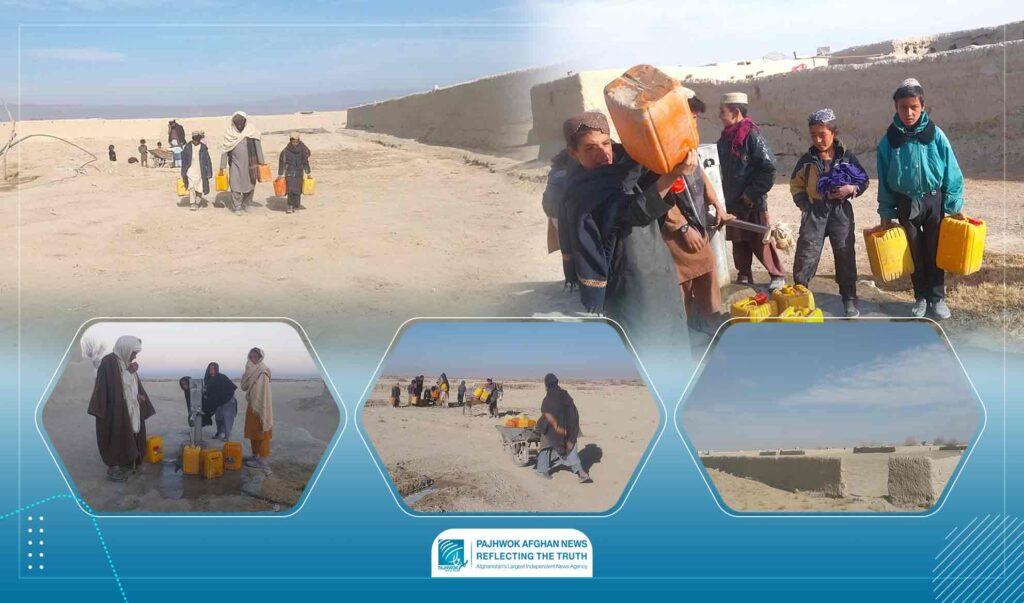

KABUL (Pajhwok): Every early morning, the clatter of donkeys’ hooves, rattling of handcarts and the sound of water containers break the village silence as residents walk for up to an hour to fetch water from wells, some of which supply water to villagers for only half an hour after every hour.
For some, the walk takes half an hour, while for others it lasts up to an hour, depending on where they live. Some residents live at one end of the village, others at the opposite end and some travel around four kilometres to an area known as Chaman to fetch water.
This is the daily reality for residents of Nawabkhel, Salamkhel and Angar villages in Nawa district of southern Ghazni province— villages home to around 450 families.
Residents say if the problem is not resolved, they may be forced to leave the area.
Villagers’ stories
Residents of these villages say they set out early every morning to reach the wells and secure their turn. Some people remain there until late evening. Water is taken home on donkeys or handcarts, while others are forced to carry it on their shoulders.
They say each household dug three or four wells, but over time these dried up as groundwater levels dropped.
Currently, only ten wells remain across the three villages, and even these contain very limited water.
Allah Nazar, a 65-year-old resident of Nawabkhel village, stands with a stick in his hand alongside his children, awaiting his turn at the village well, which villagers dry up within half an hour.
He says once the water was depleted, villagers must wait up to an hour for the well to recharge before drawing water again.
“People in the village do not get enough water and many times I return home empty-handed,” he said.
He added that if the situation continues, residents would be forced to abandon their homes and migrate elsewhere.
“Here, not only do people lack drinking water, but there is also no water for livestock or irrigating farmland,” he said.
Mohammad Rahim, another resident of the village, also complained about water shortages, saying the lack of water has become such a serious problem that it threatens villagers’ daily lives, agriculture and future.
He said even the available well water was initially somewhat clean, but later turns muddy and unsuitable for drinking.
Dilawar Taraki, another resident, stands beside a well that provides water for a short time before drying up again.
He said Nawabkhel has only four wells, all with limited water and villagers sometimes walk four kilometres to Chaman to fetch drinking water.
“These four wells are our village’s last hope,” he said.
Residents say their livelihoods depend entirely on agriculture and livestock, but water shortages have nearly destroyed this fundamental source of survival.
Taraki said agriculture in the area was now on the verge of collapse and that the canals had dried up long ago.
“In the past, after the karezes, we used machines and wells to extract water for our fields. When the water table dropped further, we dug deeper wells and used solar systems, but now even those have mostly dried up, and the remaining ones provide very little water. It is not enough. People are desperately searching for drinking water, and the same applies to farmland,” he added.
According to him, only a few better-off residents with deep wells can grow small quantities of onions, alfalfa and potatoes. Ordinary villagers cannot afford this.
He said wells dug for agricultural purposes only irrigate the land of those individuals to a limited extent.
Haji Kalam, a 55-year-old resident of Salamkhel village in Nawa district, said he had never experienced such dire conditions in his life, but was now enduring them painfully.
“We used to have karezes for both irrigation and drinking water, but they dried up 14 years ago. Our land has no water, people struggle severely to find drinking water, and livestock farming is also nearing collapse,” he said.
He added that villagers now walk four kilometres on foot to bring water from wells in the Chaman area, using donkeys and handcarts, while some carry water containers on their shoulders throughout the long journey.
Residents of Angar village, located near Nawabkhel, face similar problems.
Mohammad Anwar, a resident of Nawabkhel village, said residents of Angar village, like those of Nawabkhel and Salamkhel, were also suffering from water shortages.
Head of the Health and Water Supply Section at the Rural Rehabilitation and Development Department Eng. Hamidullah did not provide specific details about these villages but said the department had implemented 24 solar-powered water supply projects in various districts of the province.
“These projects provide each person with 40 litres of clean water per day. We also plan to implement 34 additional projects in some other districts of Ghazni next year,” he said.
Climate affairs analyst Mir Shakib Mir said the drying up of karezes and water sources was a direct result of climate change, as well as long-standing weaknesses in water management in Afghanistan.
“Unfortunately, in the long term, this situation negatively affects the economy, increases poverty, creates social problems, damages the environment and impacts public health,” he said.
He stressed that as a first step, Afghanistan’s water resources must be managed professionally, scientifically and effectively. At the same time, government sectors and relevant institutions should work closely with communities and raise public awareness about climate change and water resource challenges.
He added that serious attention must be given to the effective and proper use of water resources, and that factors contributing to drought and the worsening effects of climate change on water should be carefully examined and managed.
Mir also emphasised the importance of expanding greenery, restoring vegetation cover and increasing green spaces in Afghanistan, noting that increased greenery can reduce the negative impacts of climate change and positively affect water resources.
Last month, the United Nations International Children’s Emergency Fund (UNICEF) said in its latest report that worsening water shortages in Afghanistan had put the health and livelihoods of millions at serious risk, as nearly 80 percent of the population was forced to use unsafe water.
The agency warned that prolonged droughts, declining groundwater levels and recurring natural disasters had severely limited access to clean water across the country.
kk/ma

GET IN TOUCH
NEWSLETTER
SUGGEST A STORY
PAJHWOK MOBILE APP