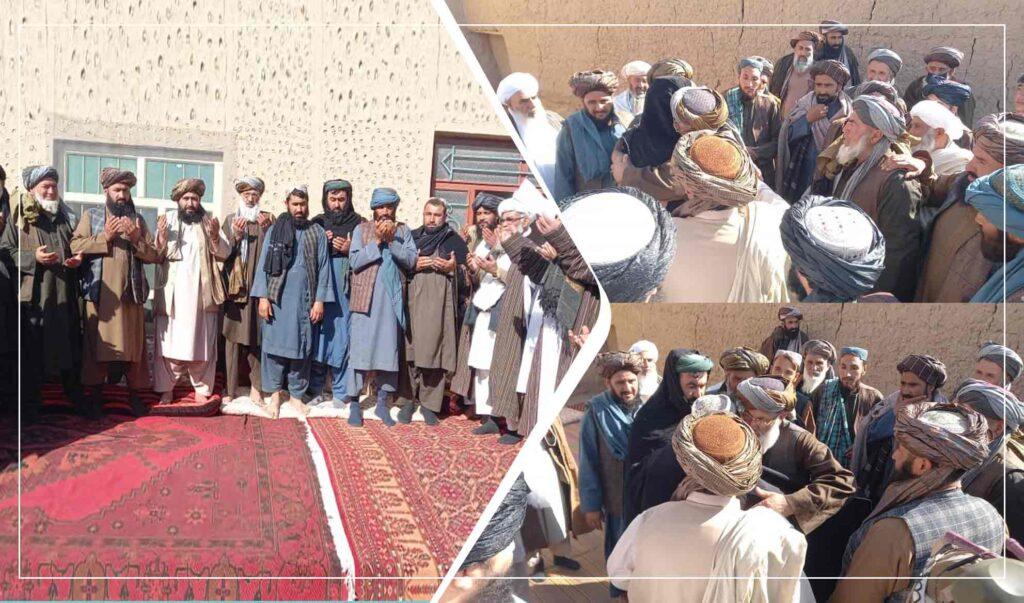

KABUL (Pajhwok): Analysts say the resolution of over 3,500 disputes across nearly four years demonstrates that local bodies and tribal elders are working in coordination, promoting dialogue, understanding and peaceful conflict resolution at low cost, encouraging Afghans to favour discussion over violence.
Historically, Afghanistan has been regarded as a country of jirgas and councils—a tradition that for centuries has formed an integral part of the country’s social structure and has been considered one of the most trusted mechanisms for resolving tribal, legal and social disputes.
For this reason, many people continue to turn to jirgas alongside, or instead of, formal courts and the practice remains an important instrument for social stability and reconciliation.
In recent years, greater attention has been paid to the issue. The Ministry of Borders and Tribal Affairs (MoBTA) reported that as many as 1,372 major and 2,193 minor disputes have been resolved across the country through jirgas by religious scholars, tribal elders, and local officials since the re-establishment of the Islamic Emirate of Afghanistan (IEA).
The ministry noted that 1,332 people had suffered casualties in these disputes.
Deputy Minister of Borders and Tribal Affairs in the previous government, Mohammad Yaqoob Ahmadzai, told Pajhwok Afghan News that support from the IEA for jirgas and respect for their decisions had encouraged people to pursue dialogue and mutual understanding rather than resorting to violence.
He described the tradition as a positive and valuable development for society. Ahmadzai explained that jirga decisions are not imposed but rather made fairly with the consent and satisfaction of both parties, after granting the council the authority to adjudicate.
According to him, jirga decisions do not conflict with the judicial and legal system; instead, they have helped to ease the burden on the courts.
Ahmadzai added: “In the past, when disputes arose and could not be resolved by the courts, cases were referred to jirgas and councils. Tribal elders and respected figures would sit together and find solutions acceptable to the people. That is why, whether large or small, jirgas and councils have always commanded respect and acceptance.”
He noted that while court rulings often leave one party dissatisfied, a jirga seeks a decision that satisfies both sides, bringing a lasting end to disputes.
He suggested that endorsing jirga decisions by local departments could further strengthen their effectiveness and credibility, arguing that official confirmation and a formal seal would increase people’s commitment.
He said that since the IEA’s return to power, many long-standing feuds have ended and trust among communities has strengthened. When disputes are resolved peacefully and by mutual consent, pressure on judicial institutions is reduced, while stability, brotherhood and security within society are reinforced.
Religious scholar Noorullah Kawsar also stated that the resolution of over 3,500 disputes in nearly four years demonstrates coordination between local entities and tribal elders, and efforts to settle conflicts quickly, inexpensively, and peacefully.
He emphasised that systematic documentation, monitoring, and adherence to Sharia and legal principles could further enhance the effectiveness and credibility of the jirga process.
Kawsar explained that jirgas and peace councils are regarded in Islam as “gatherings of goodness,” and the Holy Qur’an also refers to such assemblies as beneficial gatherings.
He noted that peace, reconciliation, and jirga meetings are virtuous, resolving disputes, reconciling people, and addressing societal problems.
He added that Islamic jurisprudence includes a specific chapter, “Kitab al-Sulh” (The Book of Reconciliation), which sets out rules and principles governing settlement and reconciliation between people, reflecting the importance of peace and jirgas.
Kawsar said that Afghanistan has a long history of jirgas and consultative assemblies and for hundreds of years Afghans have used jirgas, peace councils and consultations to resolve numerous disputes, including legal matters, family conflicts, murder cases, and other social problems.
Councils for peace and reform are highly valuable as they reduce hostility, promote affection and goodwill, create opportunities for forgiveness and ultimately guide society towards goodness and prosperity, he concluded.
sa