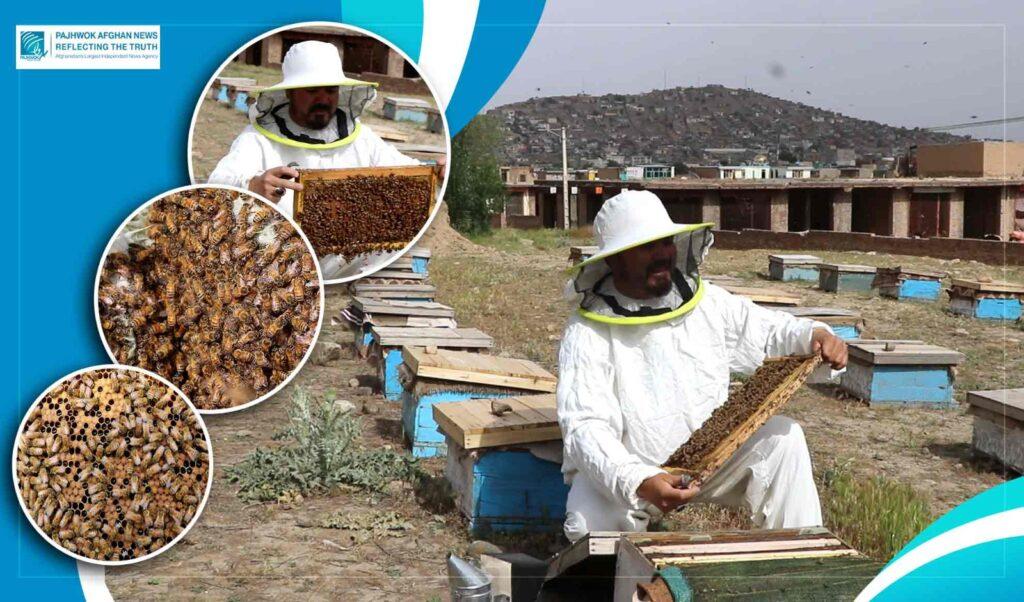

KABUL (Pajhwok): On World Bee Day, a member of the Afghanistan Beekeepers Union says that despite the expansion of beekeeping farms and increased honey production capacity, large-scale imports of foreign honey and the lack of modern equipment have created serious challenges for the industry.
World Bee Day is observed annually on May 20 to raise public awareness about the important role of bees in pollinating plants, preserving biodiversity and ensuring food security.
On the occasion, Pajhwok Afghan News interviewed a member of the Afghanistan National Beekeepers Union and a number of beekeepers.
Mujib-ur-Rahman Shahab, head of the Maidan Wardak Beekeepers Union and cultural officer of the Afghanistan National Beekeepers Union, said the beekeeping industry in the country began years ago and that nearly 4,000 beekeeping farms are now operating across Afghanistan.
He said around 6,000 people are employed in the sector, 20 percent of them women.
He described women’s role in the growth of the industry as important, saying some own private farms while others work in partnership.
Shahab added that if each farm had an average of 200 beehives, the total number of hives in the country would reach around 800,000 and, in a normal year, nearly 12,000 tonnes of honey could be produced.
He described nationwide security as one of the factors behind the growth of the industry, saying beekeepers can now move their bees to different provinces, whereas previously many were forced to transfer them to Pakistan during the winter season.
According to Shahab, the replacement of poppy cultivation with basil farming in some southern provinces has also benefited beekeeping because basil has become an important food source for bees.
He described the establishment of a honey quality-testing laboratory by the Ministry of Agriculture, Irrigation and Livestock (MoAIL) as an important step, but stressed that the sector still faces serious challenges.
According to him, the lack of modern equipment, the continued keeping of some Afghan bee colonies in Pakistan, large-scale imports of foreign honey and weak bee breeds are among the major problems facing the industry.
He urged the Pakistani government to facilitate visa issuance for Afghan beekeepers.
Shahab also called on the Islamic Emirate of Afghanistan (IEA) to impose higher taxes on imported honey or restrict imports in order to support domestic production.
He said that if modern equipment were provided, beekeepers could produce not only honey but also royal jelly and bee venom — products with high economic value in international markets.
Shah Mohammad, a 60-year-old beekeeper who has worked in the sector for nearly 35 years, said he previously owned between 700 and 800 beehives, but that number has now dropped to between 40 and 50.
He blamed the decline on imported honey and said: “Foreign honey is imported into Afghanistan at low prices, which has reduced our income. Due to the economic situation, people mostly buy those products and we have been forced to lower the prices of domestic honey.”
Shah Mohammad said the problems of beekeepers received little attention in the past, but with the establishment of unions their voices have somewhat reached officials.
He asked the government to support domestic beekeepers and limit the import of foreign honey.
Meanwhile, Abdullah Amiri, manager of the Baharan Beekeeping Farm and secretary of the Maidan Wardak Beekeepers Union, said he has been working in the sector for about 11 years.
He added that his farm currently has around 120 beehives and the number increases to between 200 and 250 throughout the year.
According to him, the reproduction of bees is directly dependent on weather conditions and the natural environment. He said this year has been favourable for beekeeping due to sufficient rainfall.
Abdullah Amiri stressed that if weather conditions are unfavourable and flowers and plants are scarce, beekeepers cannot achieve good harvests.
He added that the honey harvesting season has not yet started at his farm, but if weather conditions remain suitable, the first harvest will take place in about 15 days.
Meanwhile, Mawlawi Sher Mohammad Hatami, spokesman for the Ministry of Agriculture, Irrigation and Livestock, said: “The ministry is implementing various activities to support beekeepers and promote the sector, including technical consultations, facilitating the establishment of new farms and combating diseases and pests.”
According to him, there are currently 3,200 beekeeping farms across the country, producing 2,200 metric tonnes of honey annually.
kk/sa