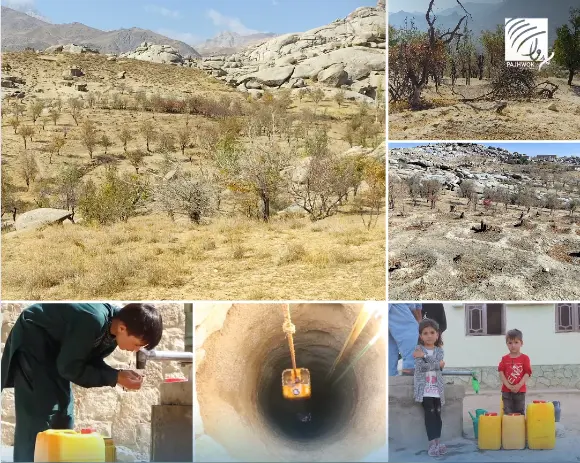
NEILI (Pajhwok): Drying wells and declining groundwater levels in Neili, the capital of central Daikundi province, have forced some families to rely on water tankers. They pay high prices to meet their daily needs but remain uncertain about the quality and safety of the water they buy.
Climate change and rising global temperatures are threatening livelihoods around the world by disrupting rainfall patterns, intensifying drought and depleting water resources.
Afghanistan is particularly vulnerable because a large proportion of its population depends on agriculture and livestock farming.
Declining rainfall, early snowmelt and the drying up of springs and wells, particularly in Daikundi, have made it increasingly difficult for families to access drinking water and water for agriculture, affecting their food security and incomes.
Wells dry up, making water increasingly difficult to obtain
Ghulam Ali, a resident of Neili Township, told Pajhwok Afghan News that groundwater levels in his neighbourhood had fallen sharply and wells had dried up, bringing farming in the area to a halt.
He said the well at his home dried up last year. After digging it deeper to around 40 metres, he managed to obtain water for a few months, but it dried up again several months ago.
“We can no longer afford to dig another well. We pay nearly 1,000 afghanis for each water tanker, but even that amount does not last us a week,” he said.
Ghulam Ali added that a well at a nearby mosque had also dried up this year, leaving families in the township dependent on water tankers.
Wajiha, another Neili resident, also complained about falling groundwater levels and drying wells. She said her large family used more than one tanker of water every week.
“We buy a tanker containing around 5,000 litres, along with 20 barrels of water, for 1,000 afghanis,” she said.
She said the cost of buying water had placed additional financial pressure on her family. Despite the expense, they sometimes still faced shortages.
Wajiha said the family used the purchased water for all its daily needs. She sometimes contacted water supply companies the night before to arrange a delivery for the following day.
However, they did not always get a delivery slot, forcing the family to spend periods without water.
She urged the government to take serious action to address the water shortage in Neili and ensure residents had access to drinking water.
Residents concerned about quality of purchased water
Alongside the shortage, some Neili residents have raised concerns about the quality of water delivered by tankers, saying they are not fully confident that it is safe to drink.
Nazifa, another resident of the township, said concerns about the quality of purchased water had added to their difficulties as wells continued to dry up.
“I am not 100 per cent sure whether the water we buy is safe to drink. That is why we usually boil it before drinking,” she said.
Nazifa said she believed contaminated water had caused health problems among residents. She said she had fallen ill several times after drinking the water and that some people had suffered from kidney problems and diarrhoea.
According to her, doctors had identified contaminated water as one of the causes of these illnesses.
She called on officials to take practical measures to address the shortage and ensure water quality so residents could access safe drinking water.
Contaminated water can cause various illnesses
Dr Allah Yar, an internal medicine specialist at Daikundi Provincial Hospital, said a lack of access to safe drinking water was a major public health concern, as the human body needed clean water for its daily functions.
He said contaminated water could cause illnesses such as diarrhoea, vomiting, abdominal pain and intestinal infections, and could lead to more serious complications in some cases.
He added that drinking water quality should be monitored and people should be provided with access to clean and safe water to prevent waterborne diseases.
He advised people without access to safe water to boil it thoroughly before drinking to eliminate disease-causing organisms.
Water seller assures residents of supply quality
Rahmatullah, a tanker water seller in Neili, said the water he supplied was safe. He said his business had an official government licence and delivered clean, treated water from selected wells or springs near people’s homes.
“We have obtained an official government licence and, as promised, deliver very clean and clear water from certain wells or springs to people’s homes. There is no need to worry about its quality,” he said.
Official says measures under way to address water shortage
Khudadad Samit, head of water affairs coordination at the Upper Helmand River Sub-basin in Daikundi, said assessments by relevant departments showed that around 3,000 families in Neili lacked access to drinking water or had only limited access.
He identified declining groundwater resources, population growth and high water consumption as factors behind the problem.
Reduced rainfall and climate change had also contributed to falling groundwater levels and drying wells, he added.
Samit said relevant departments and senior officials had been consulted to address the problem, while investors had also been encouraged to invest in water supply services.
He added that the Afghanistan Urban Water Supply and Sewerage State Company was working on a comprehensive water supply network plan for Neili. The water source and transmission route had been identified, and a survey of areas within the city had been completed.
He said two private water supply companies were also operating in areas outside the city’s master plan and had begun distributing water in some locations. Once their work was completed, access to water for some customers would improve to some extent, he added.
Samit said residents of areas covered by the city’s master plan had also submitted proposals to the department for temporary water supplies until the main water supply project was implemented.
He added that water shortages were not limited to Neili. According to a survey by relevant departments, 81 villages across Daikundi province had been affected by drought, leaving residents with limited access to drinking water.
Agriculture in various parts of the province had also suffered from the effects of drought.
Samit said monitoring of water resources was continuing to assess their quality and take necessary measures to prevent contamination.
sa