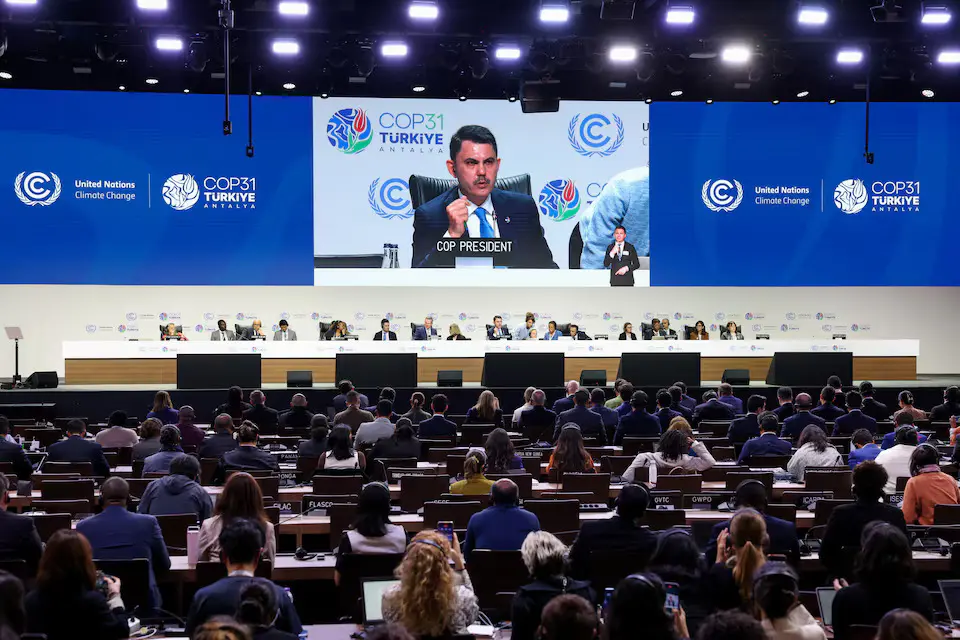
KABUL (Pajhwok): UN climate talks ended in failure on Sunday after the European Union and several other countries rejected a proposed agreement by COP31 presidents Turkey and Australia, saying it was too weak to address global warming.
Reuters reported that the failure highlighted governments’ difficulties in agreeing on ambitious measures to tackle climate change amid growing threats from heatwaves, wildfires, floods and storms, as wars and economic pressures compete for attention.
More than two weeks of negotiations extended two days beyond the deadline, making the summit the longest UN climate conference on record, but delegates failed to reach an agreement.
“There is nothing to do. We did all that we could,” Turkey’s conference president Murat Kurum told the closing plenary, ruling out any new draft text.
He later left the stage while country representatives were still delivering their statements.
Australia’s COP31 president of negotiations, Chris Bowen, described the outcome as “very disappointing”, citing disagreements over fossil fuels and climate finance.
UN Secretary-General Antonio Guterres also expressed frustration.
“I share the very profound frustration of all those who expected governments to rise to the moment the climate crisis demands,” he said.
The last time UN climate talks failed to adopt an agreement was in Copenhagen in 2009.
Despite disagreements at recent summits, analysts say the conferences have encouraged business investment and advances in renewable energy and electric vehicles, while helping to limit global warming.
When countries adopted the Paris Agreement in 2015, projections suggested existing policies would lead to around 4 degrees Celsius of warming this century. A decade later, the projection has fallen to 2.8 degrees.
This year’s summit was the first since the UN’s environmental body confirmed in October that global temperatures were on course to exceed the 1.5-degree Celsius threshold, beyond which scientists warn extreme weather impacts would intensify.
Ireland’s Environment Minister Darragh O’Brien said the EU could not support the proposed deal partly because it made no reference to fossil fuels.
“It is unconscionable that we would have a climate act that makes no reference to fossil fuel, no reference to transitioning away from fossil fuels,” he said.
Saudi Arabia and other major oil-producing countries maintain that fossil fuels will remain part of the global economy for the foreseeable future. Summit observers said Saudi Arabia had lobbied to exclude references to fossil fuels from the proposed text.
The draft acknowledged the expected overshoot of the 1.5-degree threshold and called for faster development of carbon-removal technologies. Oil-producing countries had supported this provision.
Scientists say carbon removal, alongside substantial emissions cuts, is essential to limiting climate change. However, critics warned that the provision could be used to justify continued oil production.
A representative of the Saudi delegation told the closing plenary he was surprised by opposition to what he described as a concrete solution to global warming.
sa