
KABUL (Pajhwok): Construction work on the second Jabal Saraj cement plant in central Parwan province officially began on Thursday. The plant will have a production capacity of 5,000 tonnes of cement per day.
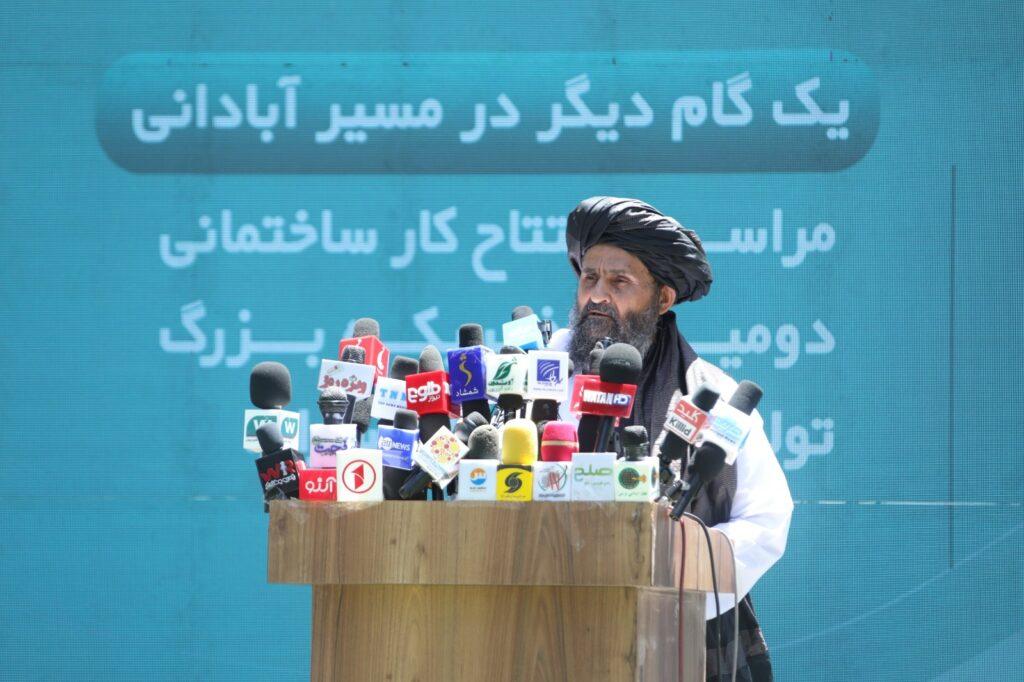
The inauguration ceremony was attended by Deputy Prime Minister for Economic Affairs Mullah Abdul Ghani Baradar, Deputy Prime Minister for Administrative Affairs Mawlawi Abdul Salam Hanafi, Director-General of the Administrative Office Sheikh Noor-ul-Haq Anwar, the governor of Parwan and a number of other senior officials.
Addressing the ceremony, Mullah Baradar described the project as a significant milestone for Afghanistan.
“This is not merely a factory; it represents Afghanistan’s economic progress, self-sufficiency and future economic stability,” he said.
He added that countries which had developed their industrial sectors had achieved significant economic progress, stressing that Afghanistan’s geographical location offered strong potential for industrial development.
The deputy prime minister described cement as a cornerstone of the construction sector, saying self-sufficiency in cement production would boost national revenues and create employment opportunities for Afghan citizens.
He said every new factory strengthened the national economy and called on both domestic and foreign investors to invest in Afghanistan across various sectors.
“Economic development cannot be achieved by the government alone. The government, the private sector and the people must work together,” he added.
Deputy Prime Minister for Administrative Affairs Mawlawi Abdul Salam Hanafi described the project as a major step towards the country’s industrialisation, particularly in Parwan province.
He said the plant had been designed as a modern, standard facility with the capacity to produce 5,000 tonnes of cement every 24 hours, meeting a substantial share of domestic demand.
According to Hanafi, increased domestic production would help lower cement prices and contribute to greater stability in Afghanistan’s construction sector.
He added that the factory would strengthen Parwan province’s position, particularly that of the historic Jabal Saraj district, on the country’s industrial map.
Parwan Governor Sheikh Abdul Rahman Mansour said the project marked the beginning of a new chapter in Afghanistan’s economic development and self-reliance.
He said Afghanistan had become a safe and suitable destination for investment after years of insecurity and that the project sent a strong message to domestic and foreign investors that Parwan was ready to host both small- and large-scale investments.
Mansour said the factory would not only contribute to self-sufficiency in cement production but also create hundreds of direct and thousands of indirect jobs, helping strengthen the country’s economy.
He added that the local administration would ensure a reliable electricity supply for investors and industrial facilities.
Meanwhile, Mohammad Jan Bilal, head of State-Owned Enterprises, described the inauguration as a landmark in Afghanistan’s industrial development.
He said the new plant represented a major breakthrough and expressed confidence that Afghanistan would soon become self-sufficient in cement production, eliminating the need for imports.
Minister of Mines and Petroleum Mullah Hedayatullah Badri also described the inauguration as a significant achievement.
According to the National Development Company (NDC), the second Jabal Saraj cement plant will have the capacity to produce 5,000 tonnes of cement every 24 hours.
The company said the plant had been designed as a modern industrial complex and that all financial and technical aspects of the project were being funded and implemented by the NDC.
It added that the factory would meet a large share of Afghanistan’s construction and infrastructure needs through domestic production.
According to the company, all stages of production—from clinker manufacturing to cement packaging—will be carried out at the plant, reducing production costs and helping Afghanistan eliminate its dependence on imported cement.
The company also said environmental protection standards had been incorporated into the design and construction of the plant to minimise air pollution during the production process.
kk/sa