



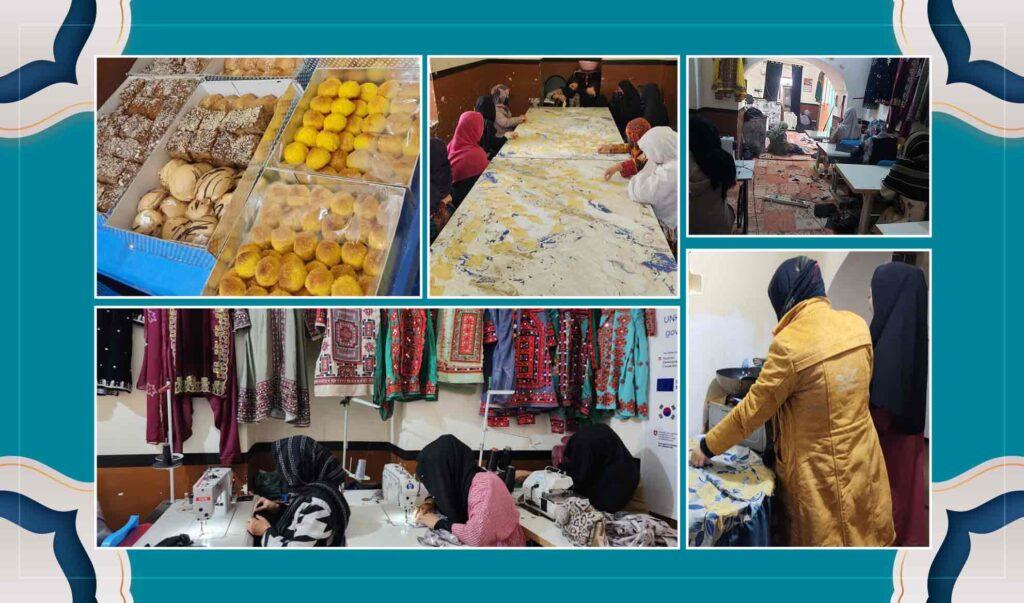

ZARANJ (Pajhwok): Following the publication of a Pajhwok report on the economic problems of returnee migrants in Nimroz, two women’s tailoring workshops in Zaranj city, the provincial capital, have provided employment and training opportunities for dozens of returning women and girls.
On October 12, Pajhwok published a report titled, “Returnees in Nimroz face hardship, trauma, seek shelter,” in which returnees complained about economic hardships and called for the creation of job opportunities.
After the publication of this report, the tailoring workshops “Taj-i-Noqra” and Rahail-Bano took steps to recruit returning women—an initiative that brought satisfaction to the returning migrants.
Taj-i-Noqra tailoring workshop
Lailuma Sarwari, head of the Taj-i-Noqra tailoring workshop in Zaranj, told Pajhwok Afghan News: “The Pajhwok report made me aware and helped us understand that migrants are returning to the country empty-handed; they have neither jobs nor shelter and face psychological problems. For this reason, I decided to provide job opportunities for migrant women and girls. I started admissions a month ago, and now 75 women are working with us as instructors and trainees.”
She added that her workshop has absorbed these women in four sections: tailoring and embroidery, confectionery, cooking, and macramé weaving. In addition to earning income from the workshop, these women are also supported by some international organizations.
According to Sarwari, about a week ago one organization placed the confectionery section of her workshop under its support due to the inclusion of migrants. It distributed 20 types of work tools to 15 trainees receiving training in this section and allocated salaries for the instructors.
She noted that another organization has installed a solar power system for the workshop.
Expressing appreciation for Pajhwok’s reporting, she said: “One of your reports about my workshop was published in Hamal 1402. That report changed my life. After its publication, I received three partnership offers from several traders who had initially refused to cooperate. When they read your report, they realized that my work was genuine and that I only lacked financial support, so they began partnering with me.”
Rahil Bano workshop
Najla Yousafzai, head of the Rahil Bano tailoring workshop, also said that after the publication of the Pajhwok report on migrants, she recruited 20 returning girls and women in her workshop.
Thanking Pajhwok, she said: “Although I was aware of the situation of migrants, reading the report deeply affected me and increased my awareness. I decided to provide employment and training opportunities for a number of these women in my workshop.”
Newly employed women
Zainab Mohammadi, an instructor in the cooking section of the Taj-i-Noqra workshop, said that four months ago, after eight years of living in Iran, she returned to Kabul: “When I came back, I was unemployed and faced many problems. I was looking for work when, finally, upon Lailuma invitation—who needed a head chef for the kitchen section—I was hired and started working.”
According to her, their economic problems have now decreased.
Zahra, an instructor in the confectionery section of the workshop, expressed happiness, saying that joining the workshop transformed her life.
She added that after returning to the country, when she had no source of income for herself and her family members, she became depressed and believed that life in Afghanistan was impossible; however, after being absorbed into the workshop, hope for life was revived within her.
She expressed gratitude to the workshop officials for providing employment opportunities for them.
sa/ma

GET IN TOUCH
NEWSLETTER
SUGGEST A STORY
PAJHWOK MOBILE APP