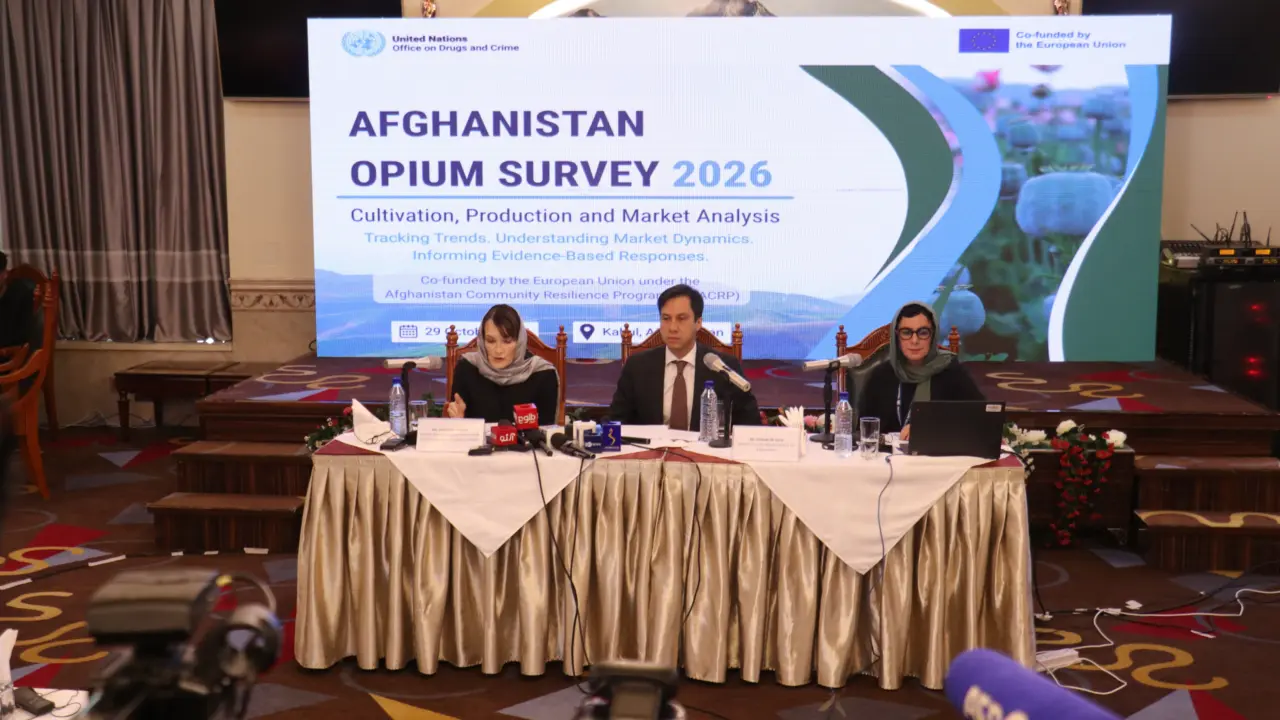
KABUL (Pajhwok): The United Nations Office on Drugs and Crime (UNODC) says its latest survey suggests that opium poppy cultivation and production in Afghanistan have increased compared with last year, although they remain below pre-ban levels in 2022.
However, the Ministry of Interior (MoI) rejects the survey’s figures, saying the level of narcotics cultivation has been reduced to almost zero.
UNODC announced the findings of its 2026 survey in Kabul today (Thursday), saying opium production had resumed in Afghanistan and increased fivefold compared with the previous year.
According to the survey, the area under opium poppy cultivation increased by 330 percent compared with last year, while opium production rose by 400 percent.
It said poppy cultivation exceeded 43,000 hectares in 2026, compared with 10,000 hectares in 2025. Estimated opium production reached nearly 1,500 tonnes this year, up from around 300 tonnes last year.
It added that although poppy cultivation and opium production remained below the levels recorded before the 2022 narcotics ban, the increase marked the first significant rise since the ban was introduced.
The report noted that efforts to eradicate poppy crops were continuing intensively. According to Afghan officials, around 22,000 hectares of poppy fields had been destroyed. At the same time, many farmers appeared to have changed their cultivation methods to avoid enforcement measures.
UNODC’s findings indicate that farmers are concealing small poppy plots within cereal fields or growing them in enclosed areas behind walls. Some are also staggering planting and harvesting schedules to reduce the risk of detection.
“The fourfold increase in opium poppy cultivation demonstrates how difficult it is to sustain reductions in illicit opium cultivation when poor farmers lack alternative ways to provide for their families,” the report said.
UNODC Executive Director Monica Juma said: “It is essential for the de facto authorities and the international community to work together to support farming communities. This support should be strengthened through investment in alternative livelihood opportunities, basic agricultural infrastructure and access to markets.”
The agency added that poppy cultivation expanded across 16 of Afghanistan’s 34 provinces in 2026, five more than in 2025.
According to UNODC, three-quarters of the land under poppy cultivation in Afghanistan in 2026 was located in the north-eastern region, reinforcing its position as the country’s main poppy-growing area. Before the narcotics ban was enforced, most poppy cultivation had taken place in the south-western part of the country.
The report also noted the price of one kilogramme of opium fell from US$570 last year to US$500 in 2026, although it remained higher than before the 2022 ban.
Juma stressed the importance of international cooperation to dismantle transnational drug-trafficking networks, provide alternative livelihoods for farmers and continue law-enforcement action against traffickers.
According to the UNODC survey, regional opium trafficking has declined in recent years but continues. Traffickers may have relied on existing opium stockpiles, but new data suggest these reserves are running out. The agency said early signs of a heroin shortage were emerging in Europe, which could further increase opium poppy cultivation and production in Afghanistan.
MoI: UNODC report contradicts realities on the ground
MoI spokesperson Mufti Abdul Mateen Qani told Pajhwok that the ministry’s Department for Counter-Narcotics strongly rejected the figures and conclusions of UNODC’s annual report on poppy cultivation and opium production in Afghanistan, saying they contradicted official data and field evidence.
The department believes the report does not accurately reflect the situation and overlooks practical achievements in the fight against narcotics.
Qani said the deputy ministry, as the responsible authority and the agency implementing operations, maintained a presence on the ground and closely monitored, documented and reported on cultivation and crop eradication.
“Relying on satellite imagery, estimates and inaccurate information from biased groups without comparing them with field data and crop-eradication records is insufficient to support definitive conclusions. The presence of a field in satellite imagery before operations begin does not mean it remains there until harvest, and it should not be used as the basis for calculating production,” he said.
The spokesperson said geographical data and field reports from the deputy ministry showed that more than 26,000 hectares of land in provinces where narcotics-producing crops had been grown were cleared of such plants in 2026. He added that the operations had been carried out under difficult field conditions and at considerable financial and human cost.
“Therefore, any assessment that fails to take these measures and their results into account in its calculations is incomplete, unreliable and unfair,” Qani said.
He added that UNODC’s estimate of approximately 43,300 hectares under poppy cultivation and nearly 1,500 metric tonnes of opium production differed fundamentally from the deputy ministry’s assessments.
According to field data cited by Qani, the identified area under narcotics-producing crops this year was around 26,000 hectares. Eradication operations were carried out before the crops reached maturity, and the deputy ministry’s assessments indicated that the remaining cultivated area had subsequently fallen to almost zero.
“UNODC should therefore clearly disclose its data sources, the dates of the satellite images, the geographical coordinates of the fields, its methodology for calculating cultivation and production, the margins of potential error in its estimates, and how official crop-eradication figures were incorporated into its final calculations,” he said.
“The responsibility for explaining the discrepancy and correcting inaccurate information rests with the institution that published the report.”
The Deputy Ministry for Counter-Narcotics stressed that an international institution’s standing could not replace credible evidence and scientific methodology. It said presenting disputed estimates as established facts without examining evidence from the responsible authorities was inconsistent with the principles of accurate and responsible reporting.
Qani said: “The efforts of counter-narcotics forces and the cooperation of the Afghan people should not be overlooked because of incomplete and one-sided assessments. International specialist reports must be protected from any influence of political considerations and should reflect realities on the ground objectively and fairly.
“Politicising technical assessments and disregarding field evidence calls into question the credibility and impartiality of international reports. Afghanistan’s practical achievements in combating narcotics should not become a casualty of political disagreements; instead, they should serve as a basis for strengthening international cooperation and supporting sustainable solutions.”
He added that a sustained fight against narcotics required not only law enforcement but also support for farmers, the development of alternative livelihoods, the promotion of legal agriculture and treatment for people with drug dependencies.
International organisations, he said, should support these efforts through accurate assessments and practical cooperation, while remaining accountable for the accuracy of the information they publish.
Qani reiterated that the deputy ministry rejected UNODC’s figures and conclusions because they contradicted official data and field evidence. He called on the agency to document the reasons for the discrepancies, review its report in light of crop-eradication data and realities on the ground, and make the necessary corrections.
hz