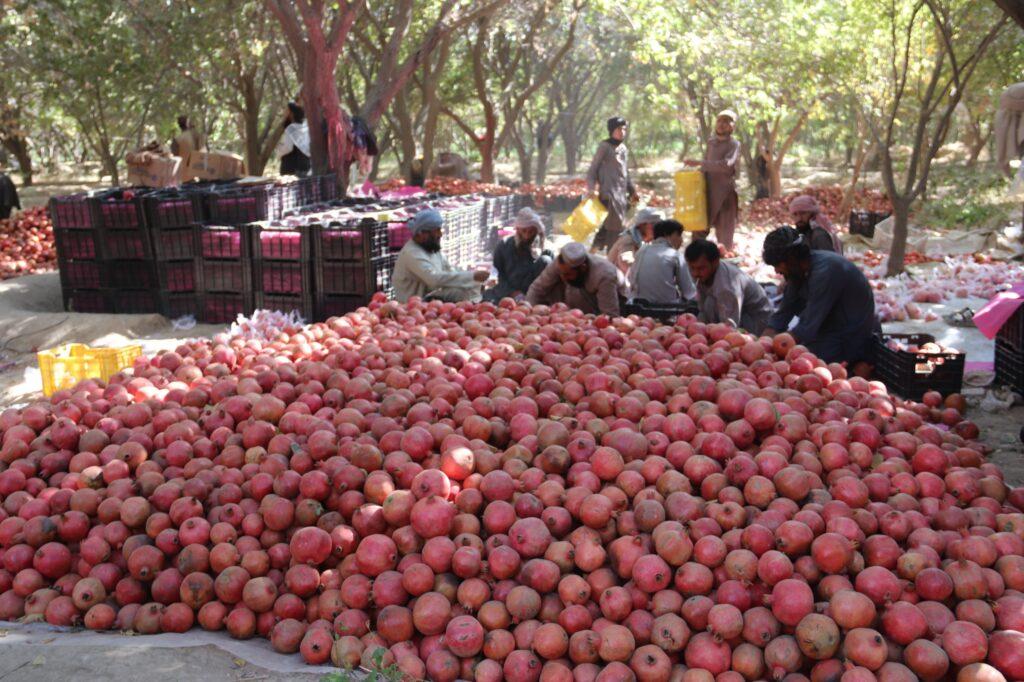

KANDAHAR CITY (Pajhwok): Pomegranate production in southern Kandahar province is expected to decline this year, while water shortages, falling prices and limited access to foreign markets are causing financial losses for growers.
Mohammad Hanif Haqmal, spokesman for the provincial Agriculture, Irrigation and Livestock Department, told Pajhwok Afghan News that pomegranate orchards covered nearly 15,000 hectares across the province’s districts.
Around 220,000 tonnes of pomegranates are expected to be harvested this year, compared with an estimated 275,000 tonnes in 2025.
He said drought had adversely affected pomegranate orchards across Kandahar, although the extent of the damage varied from district to district. Growers in Arghistan had been hit hardest, with some forced to abandon their orchards because of water shortages.
“This year, pomegranate orchards have suffered 30 per cent damage, with the worst impact in Arghistan. However, production in Arghandab and some other districts remains relatively good, as drought has had less impact there,” he said.
Water shortages, falling prices
Mirza Mohammad, a pomegranate grower in Arghandab district, said water shortages had not been such a serious problem in the past. However, declining groundwater levels had made irrigating orchards more difficult and expensive.
“We used to have water. Even when our pomegranates were damaged, we did not suffer heavy losses. Now, groundwater levels have fallen considerably, and pumping water from deep underground costs money. Meanwhile, pomegranates fetch low prices here,” he told Pajhwok.
He said limited access to foreign markets had further compounded growers’ difficulties, as low domestic prices meant they struggled to cover production and irrigation costs.
Kabul and Herat remained important domestic markets for Kandahar pomegranates, he said, but prices there were also unsatisfactory, while export opportunities remained limited.
Another grower in Arghandab, Hayatullah, said drought had damaged some of the fruit, causing many pomegranates to split and lose market value.
“On the one hand, drought has damaged the pomegranates, and many have split. On the other, there is no market for them at home. Unless foreign markets are found, Kandahar’s pomegranate growers will suffer heavy losses,” he said.
Efforts to find foreign markets
Pomegranate trader Nida Mohammad Farooqi said he had been using his business contacts to encourage foreign traders to buy pomegranates from Kandahar for export.
He said he had recently invited Russian and Uzbek traders to Kandahar to purchase pomegranates from growers and traders for export to Uzbekistan.
“We have currently signed a contract with Russian and Uzbek traders for around 80 tonnes of pomegranates. The fruit will be repackaged in Uzbekistan before being exported to Russia, Japan, Korea and some other countries. If the exports prove successful, these Russian traders may purchase up to 5,000 tonnes of pomegranates from Kandahar,” Farooqi said.
He added that if the agreements proved successful and exports expanded, growers could gain access to new markets and reduce their financial losses.
Processing offers an alternative market
Abdul Baqi Bina, deputy head of the Kandahar Chamber of Commerce, said domestic production of pomegranate juice and paste had begun last year and interest in these products was growing.
“Although pomegranate exports have declined because of border closures, the good news is that juice and paste are now being produced from pomegranates domestically. These products can be stored for longer periods and have a good market,” he told Pajhwok.
Bina said processing could offer an alternative to selling fresh fruit, as juice and paste could be stored for longer and supplied to markets over an extended period.
He added that Pakistan had previously been the main export market for Kandahar pomegranates, receiving between 50,000 and 90,000 tonnes annually. However, exports had faced difficulties since last year because trade routes between Afghanistan and Pakistan had been closed.
Kandahar’s pomegranate growers continue to face a combination of drought, rising irrigation costs and limited market access. Expanding exports and developing the fruit-processing industry could help them reach new buyers, reduce post-harvest losses and ease financial pressure.
kk/sa