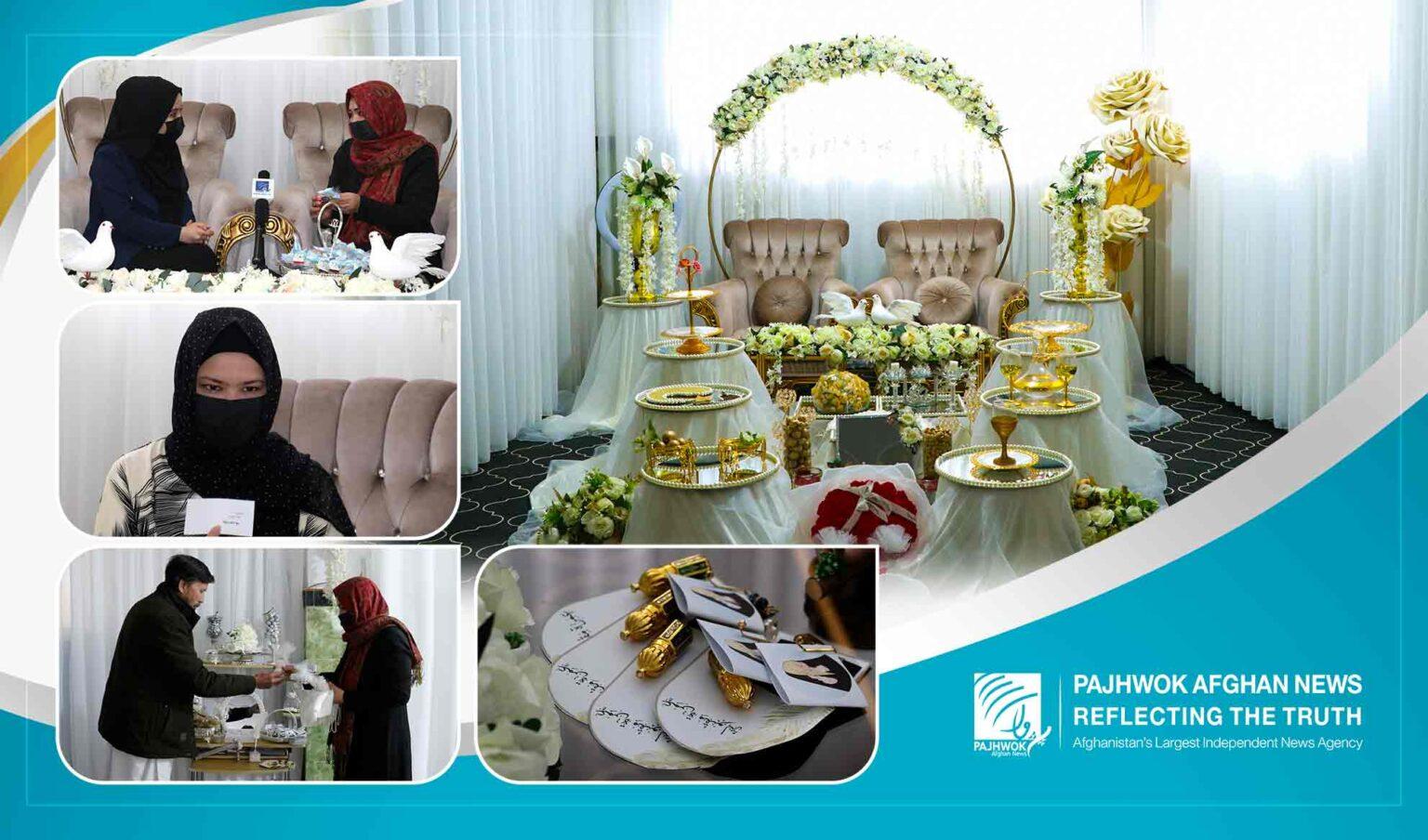
KABUL (Pajhwok): Monis Nazari, a woman who returned to the country after years of migration, says that with the support and cooperation of her husband, she has launched a new business focused on designing and organizing “nikah khana” arrangements and related accessories.
Through their joint effort, the couple has not only created a source of income for their family but has also contributed to promoting a new cultural practice and generating employment opportunities within their home.
In this report of Pajhwok Afghan News’s “Aina-i-Zan” (Women’s Mirror) program, Monis Nazari—who, after years of migration and living abroad and drawing on her work experience in Iran, established an innovative business in Kabul designing and organizing wedding “dastarkhwan” (table spread) setups—is introduced.
She is now working alongside her family to promote a new tradition and create home-based employment opportunities.
Monis Nazari is originally from the Ashiqan wa Arifan area of Kabul. She migrated to Iran with her family at the age of five, where she completed her education in the field of education and training. She also has 13 years of teaching experience.
She said: “When I was five years old, we migrated. I lived in Iran for 22 years, got married there, and completed my diploma there as well. Then we returned to Kabul.”
Nazari said that four years ago, due to unemployment and economic challenges, she and her family once again migrated to Iran and recently returned to the country.
She added that after returning, she began thinking about how to support her family financially: “I wanted to start a job that could be done from home, because I had spent 13 years away from my family and children working outside the home.”
She explained that the idea came from her experience in Iran, where she worked in decorating wedding venues and preparing items for ceremonies such as engagements and wedding receptions.
As a result, she decided to establish a “nikah dastarkhwan” (wedding ceremonial table setup) at her home, allowing couples to hold their marriage ceremonies in a special setting and turn them into lasting memories.
A small room, decorated with artificial flowers, candles, mirrors, vases, and a carefully arranged table featuring the Holy Quran, prayer mats, and various sweets, immediately captures the attention of visitors.
Nazari explains the elements of the nikah dastarkhwan: “The Holy Quran represents the guardian of the couple’s life. The mirror and candles symbolize purity and honesty. Walnuts and almonds represent prosperity. Wheat and rice symbolize livelihood. Honey represents sweetness in life. The prayer mat signifies piety and faith, and candles represent the light of a shared life.”
She said: “We all started from zero as a family and, through mutual cooperation, Alhamdulillah, we have reached this point and rebuilt our lives. From the very beginning, my husband supported me financially and professionally, and my children have always stood by me.”
She added that they have created this service so people can use their home space, with capacity to host 50 to 60 guests. According to her, the nikah dastarkhwan can also be arranged at clients’ homes or wedding halls upon request.
She further said: “In addition to the wedding table, we also prepare gifts for occasions such as engagement ceremonies, baby celebrations, henna nights, and even pilgrim gifts. Some of these we prepare ourselves, while others we bring from Iran.”
Now, four months after launching the initiative, Nazari says that two couples have already held their nikah ceremonies at the venue.
Regarding her future plans, she said: “Our effort is to introduce this culture among our people. I also hope to expand this place and turn it into a garden hall. We have a garden, and God willing, we will soon prepare it so young couples can take photos and videos in its green environment.”
In her message to other Afghan women, she said: “I tell the dear women of my country that nothing is impossible. Although economic conditions are difficult, everyone can use their abilities and create opportunities for themselves. Where there is a will, there is a way.”
Her husband, Amanullah Nazari, also confirmed his wife’s remarks, saying: “Women in Afghanistan have great potential in terms of talent and entrepreneurship and should take initiatives like my wife.”
He expressed satisfaction with her efforts, saying: “Due to the job situation in Afghanistan, we were sometimes unable to stay busy; at one point we worked in tailoring and at another we were unemployed. But when my wife started this work, we encouraged her because we considered it a good and promising idea.”
He added that he supports his wife in areas where men are more commonly involved, such as purchasing supplies, and also assists with packaging and other physically demanding tasks to ensure the smooth running of the business.
Their daughter, Fatima Nazari, a graduate of Computer Science from Kabul University, said that after returning to the country and due to changing circumstances, she was unable to find work in her field. However, she has not lost hope and continues to support her family.
She said she has joined her mother in this business, which she described as a fresh and innovative idea.
She added: “My main interest is content creation, photography, and videography, and how to introduce our products to customers. This field is somewhat related to my studies as well.”
She also encouraged Afghan girls and women, saying: “God has given all of us a creative mind that we should use. If we are able to do something, why delay it? Whatever idea comes to your mind, implement it immediately.”
sa